The Traditional Latin Mass · A free guide

The Latin Mass, explained as it happens.

What happens in each part, what the priest is praying when you can't hear him, and every word of the 1962 Low Mass in Latin and English. Explore it at home. Follow it in the pew.

Free · Latin & English · No sign-up

The Mass at a glance

The six parts of the Latin Mass. Much of it in silence.

The Low Mass runs about half an hour, always in the same order. In more than half of the priest's words, the rubrics have him pray silently, so most people never hear them. Each bar shows how much of a part you can hear. Tap one to open it.

  1. I Preparation Ad pedes altaris 10% silent
  2. II Word Missa catechumenorum 17% silent
  3. III Offertory Offertorium 87% silent
  4. IV Canon Canon Missæ 85% silent
  5. V Communion Communio 61% silent
  6. VI Dismissal Conclusio 7% silent
  • Aloud
  • Half aloud
  • Silent

By word count of the fixed Latin text. The parts that change daily are not counted.

The guide

The Latin Mass in 21 moments, in Latin and English

Each moment says what is happening and gives you one line to hold on to. Open any of them for every word.

How to follow the Latin Mass from the pew: every word, in order. Silent prayers are marked, and the parts that change daily are shown where they fall; your parish sheet or hand missal has them, and so does Divinum Officium.

Part I

Preparation Ad pedes altaris

The priest does not go straight to the altar. At the foot of the steps he and the server pray Psalm 42 in alternation, then each confesses his sins to God and asks the other's prayers.

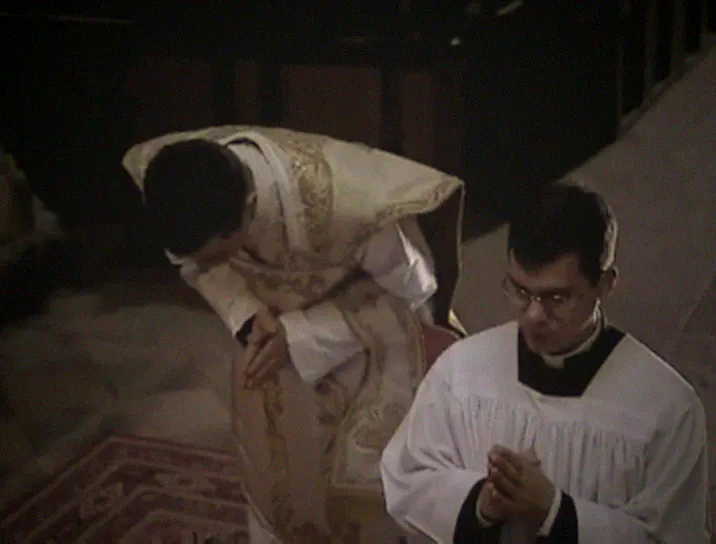
Watch for Two confessions, priest first and then server, each with three strikes of the breast at “mea culpa”.

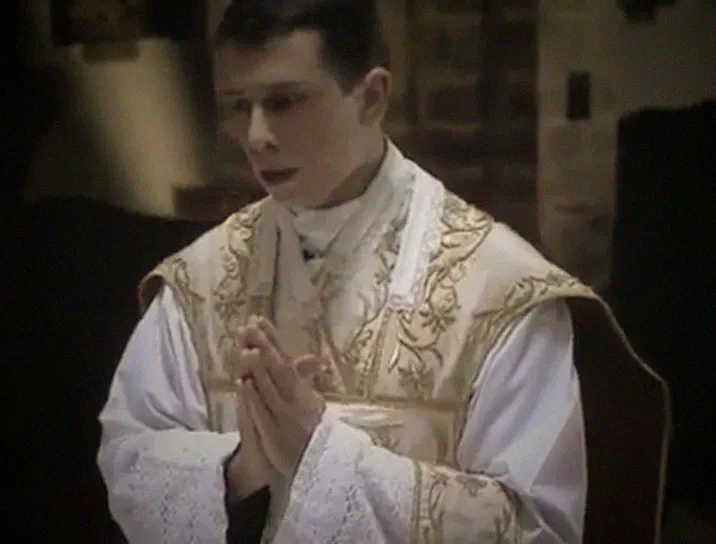
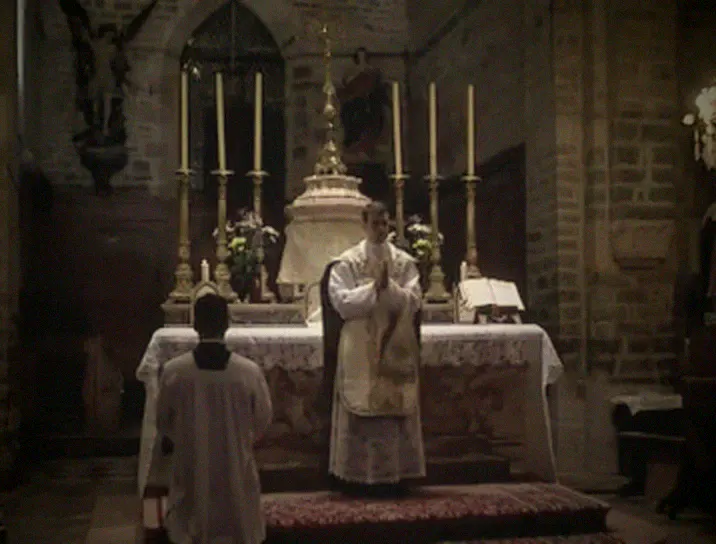
  1. The priest bows low at the foot of the altar for the Confiteor while the server kneels.
    1 Partly silent

    Prayers at the Foot of the Altar Ad pedes altaris

    Before he goes up to the altar, the priest stands at the bottom of the steps and prays Psalm 42 with the server, then each confesses his sins and asks the other's prayers.

    Introíbo ad altáre Dei.

    I will go in to the altar of God.

    He makes the Sign of the Cross.

    Priest

    In nómine Patris, ✠ et Fílii, et Spíritus Sancti. Amen.

    In the Name of the Father, and of the Son, ✠ and of the Holy Ghost. Amen.

    Introíbo ad altáre Dei.

    I will go in to the altar of God.

    Server

    Ad Deum, qui lætíficat juventútem meam.

    To God who giveth joy to my youth.

    Priest

    Júdica me, Deus, et discérne causam meam de gente non sancta: ab hómine iníquo et dolóso érue me.

    Judge me, O God, and distinguish my cause from the nation which is not holy: deliver me from the unjust and deceitful man.

    Server

    Quia tu es, Deus, fortitúdo mea: quare me repulísti, et quare tristis incédo, dum afflígit me inimícus?

    For Thou, O God, art my strength: why hast Thou cast me off? and why go I sorrowful whilst the enemy afflicteth me?

    Priest

    Emítte lucem tuam et veritátem tuam: ipsa me deduxérunt, et adduxérunt in montem sanctum tuum et in tabernácula tua.

    Send forth Thy light and Thy truth: they have conducted me and brought me unto Thy holy mount, and into Thy tabernacles.

    Server

    Et introíbo ad altáre Dei: ad Deum, qui lætíficat juventútem meam.

    And I will go in to the altar of God: to God who giveth joy to my youth.

    Priest

    Confitébor tibi in cíthara, Deus, Deus meus: quare tristis es, ánima mea, et quare contúrbas me?

    To Thee, O God, my God, I will give praise upon the harp; why art thou sad, O my soul, and why dost thou disquiet me?

    Server

    Spera in Deo, quóniam adhuc confitébor illi: salutáre vultus mei, et Deus meus.

    Hope in God, for I will still give praise to Him: the salvation of my countenance and my God.

    Priest

    Glória Patri, et Fílio, et Spirítui Sancto.

    Glory be to the Father, and to the Son, and to the Holy Ghost.

    Server

    Sicut erat in princípio, et nunc, et semper: et in sǽcula sæculórum. Amen.

    As it was in the beginning, is now, and ever shall be, world without end. Amen.

    Priest

    Introíbo ad altáre Dei.

    I will go in to the altar of God.

    Server

    Ad Deum, qui lætíficat juventútem meam.

    To God who giveth joy to my youth.

    Priest

    Adjutórium nostrum ✠ in nómine Dómini.

    Our help ✠ is in the Name of the Lord.

    Server

    Qui fecit cælum et terram.

    Who made heaven and earth.

    Bowing low, the priest confesses first.

    Priest

    Confíteor Deo omnipoténti, beátæ Maríæ semper Vírgini, beáto Michaéli Archángelo, beáto Joánni Baptístæ, sanctis Apóstolis Petro et Paulo, ómnibus Sanctis, et vobis, fratres: quia peccávi nimis cogitatióne, verbo et ópere: mea culpa, mea culpa, mea máxima culpa. Ideo precor beátam Maríam semper Vírginem, beátum Michaélem Archángelum, beátum Joánnem Baptístam, sanctos Apóstolos Petrum et Paulum, omnes Sanctos, et vos, fratres, oráre pro me ad Dóminum, Deum nostrum.

    I confess to almighty God, to the blessed Mary ever Virgin, blessed Michael the Archangel, blessed John the Baptist, the holy Apostles Peter and Paul, to all the Saints, and to you, brothers, that I have sinned exceedingly in thought, word, and deed, Here he strikes his breast thrice. through my fault, through my fault, through my most grievous fault. Therefore I beseech the blessed Mary, ever Virgin, blessed Michael the Archangel, blessed John the Baptist, the holy Apostles Peter and Paul, all the Saints, and you, brothers, to pray to the Lord our God for me.

    Server

    Misereátur tui omnípotens Deus, et, dimíssis peccátis tuis, perdúcat te ad vitam ætérnam.

    May almighty God be merciful to thee, and forgiving thy sins, bring thee to everlasting life.

    Priest

    Amen.

    Amen.

    Now the server confesses, for himself and the people.

    Server

    Confíteor Deo omnipoténti, beátæ Maríæ semper Vírgini, beáto Michaéli Archángelo, beáto Joánni Baptístæ, sanctis Apóstolis Petro et Paulo, ómnibus Sanctis, et tibi, pater: quia peccávi nimis cogitatióne, verbo et ópere: mea culpa, mea culpa, mea máxima culpa. Ideo precor beátam Maríam semper Vírginem, beátum Michaélem Archángelum, beátum Joánnem Baptístam, sanctos Apóstolos Petrum et Paulum, omnes Sanctos, et te, pater, oráre pro me ad Dóminum, Deum nostrum.

    I confess to almighty God, to the blessed Mary ever Virgin, blessed Michael the Archangel, blessed John the Baptist, the holy Apostles Peter and Paul, to all the Saints, and to you, Father, that I have sinned exceedingly in thought, word, and deed, through my fault, through my fault, through my most grievous fault. Therefore I beseech the blessed Mary, ever Virgin, blessed Michael the Archangel, blessed John the Baptist, the holy Apostles Peter and Paul, all the Saints, and you, Father, to pray to the Lord our God for me.

    Priest

    Misereátur vestri omnípotens Deus, et, dimíssis peccátis vestris, perdúcat vos ad vitam ætérnam.

    May almighty God be merciful to thee, and forgiving thy sins, bring thee to everlasting life.

    Server

    Amen.

    Amen.

    Priest

    Indulgéntiam, ✠ absolutiónem et remissiónem peccatórum nostrórum tríbuat nobis omnípotens et miséricors Dóminus.

    May the ✠ almighty and merciful Lord grant us pardon, absolution, and remission of our sins.

    Server

    Amen.

    Amen.

    Priest

    Deus, tu convérsus vivificábis nos.

    O God, Thou wilt turn again and quicken us.

    Server

    Et plebs tua lætábitur in te.

    And thy people shall rejoice in Thee.

    Priest

    Osténde nobis, Dómine, misericórdiam tuam.

    Show us, O Lord, Thy mercy.

    Server

    Et salutáre tuum da nobis.

    And grant us Thy salvation.

    Priest

    Dómine, exáudi oratiónem meam.

    O Lord, hear my prayer.

    Server

    Et clamor meus ad te véniat.

    And let my cry come before Thee.

    Priest

    Dóminus vobíscum.

    The Lord be with you.

    Server

    Et cum spíritu tuo.

    And with thy spirit.

    He goes up the steps to the altar, praying silently.

    Priest

    Orémus.

    Let us pray.

    Priest Silently

    Aufer a nobis, quǽsumus, Dómine, iniquitátes nostras: ut ad Sancta sanctórum puris mereámur méntibus introíre. Per Christum, Dóminum nostrum. Amen.

    Take away from us our iniquities, we beseech Thee, O Lord, that we may be worthy to enter with pure minds into the Holy of Holies, through Christ our Lord. Amen.

    He kisses the altar, where the relics of saints are sealed.

    Orámus te, Dómine, per mérita Sanctórum tuórum, quorum relíquiæ hic sunt, et ómnium Sanctórum: ut indulgére dignéris ómnia peccáta mea. Amen.

    We beseech Thee, O Lord, by the merits of Thy Saints, He kisses the sacred stone whose relics are here, and of all the Saints, that Thou wouldst vouchsafe to forgive me all my sins. Amen.

    History & meaning 4
    1. Once said in the sacristy

      Psalm 42, the Confiteor and the other prayers at the altar steps began as the priest's private preparation, once said in the sacristy along with many other psalms and prayers. Practice varied widely until Pius V's Missal of 1570 fixed this short set and moved it to the foot of the altar.

      Catholic Encyclopedia, “Liturgy of the Mass” (1910) ↗
    2. Why Psalm 42

      Its fourth verse, “I will go in to the altar of God,” made it the natural psalm for a priest approaching the altar. Fortescue notes that even the Missal of Paul III, in the mid-1500s, prescribed only this psalm before Mass, and the Dominicans, Carthusians and Carmelites kept just its antiphon.

      Adrian Fortescue, The Mass: A Study of the Roman Liturgy (1912), p. 225 ↗
    3. A medieval confession

      No Roman source puts a confession of sins at the start of Mass until the Middle Ages; the earliest Roman books begin Mass at the Introit. Bernold of Constance (d. 1100) is the first to quote a Confiteor as part of the Mass, and its wording varied until Pius V made one form standard.

      Catholic Encyclopedia, “Confiteor” (1908) ↗
    4. Relics in the altar

      When the priest kisses the altar during the Oramus te, the prayer names the saints whose relics are sealed inside it. The custom goes back to Mass said on martyrs' tombs, which the Liber Pontificalis credits to Pope Felix I, and it hardened into the rule that every altar must hold martyrs' relics.

      Catholic Encyclopedia, “Altar (in Liturgy)” (1907) ↗
Part II

Word Missa catechumenorum

The Introit, Kyrie, Gloria and the day's Collect, then the Epistle and the Gospel, read from opposite ends of the altar. On Sundays and greater feasts the Creed follows.

Watch for The missal moves. It starts on the right (the Epistle side) and is carried to the left for the Gospel.

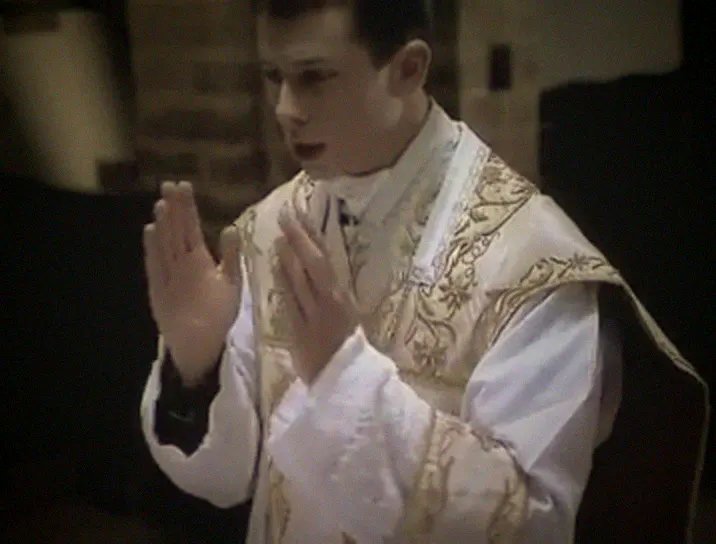
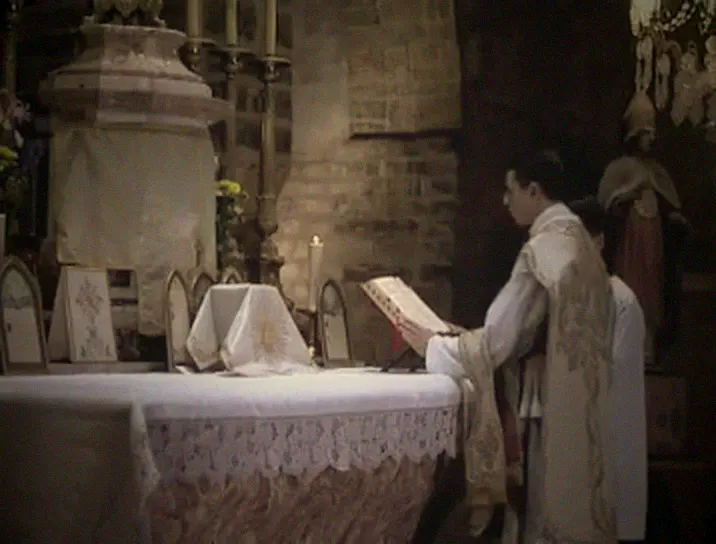
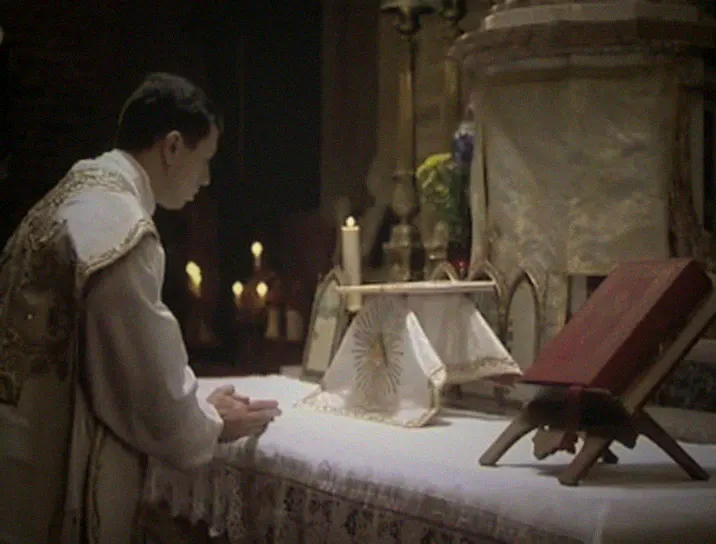
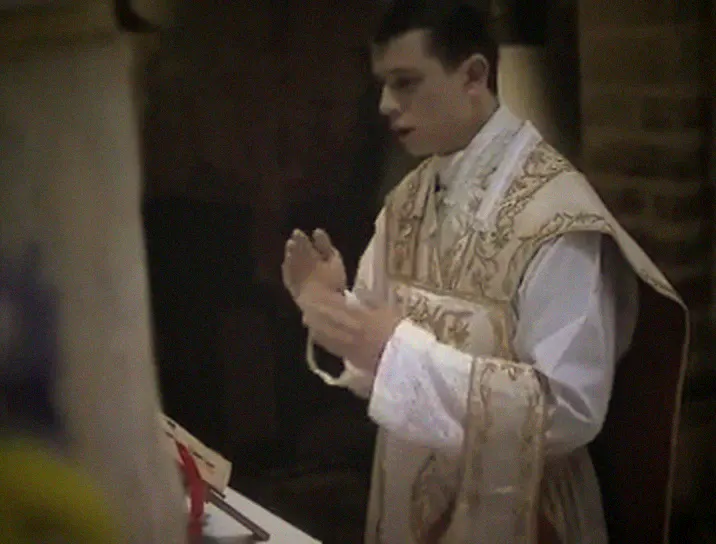
  1. The priest at the missal on the Epistle side.
    2 Changes daily

    Introit Introitus

    At the right-hand (Epistle) side of the altar the priest reads the Introit, the entrance chant, which changes with the day.

    Introitus · The Introit

    A psalm verse with its antiphon, proper to the day. He signs himself as he begins. Today's texts ↗

    History & meaning 4
    1. Once a whole psalm

      The Introit began as a full psalm sung while the clergy processed to the altar. Because its only job was to cover the entrance, the pope signalled the choir to skip to the Gloria Patri once he arrived, and by the Middle Ages only one verse was left.

      Catholic Encyclopedia, “Introit” (1910) ↗
    2. Where the Mass gets its name

      Masses are named after the opening words of their Introit. That is why a Mass for the dead is called a Requiem and the First Sunday of Advent is called Ad te levavi.

      Catholic Encyclopedia, “Introit” (1910) ↗
    3. The real beginning

      The Catholic Encyclopedia treats the Introit, not the prayers at the foot of the altar, as the true start of Mass, since everything before it is the priest's own preparation. That is why he makes the sign of the cross as he begins it.

      Catholic Encyclopedia, “Introit” (1910) ↗
    4. No entrance, no Introit

      The Easter Vigil Mass has no Introit at all. The reason is that the Introit exists to accompany an entrance, and on such days the priest has already been at the altar for some time.

      Catholic Encyclopedia, “Introit” (1910) ↗
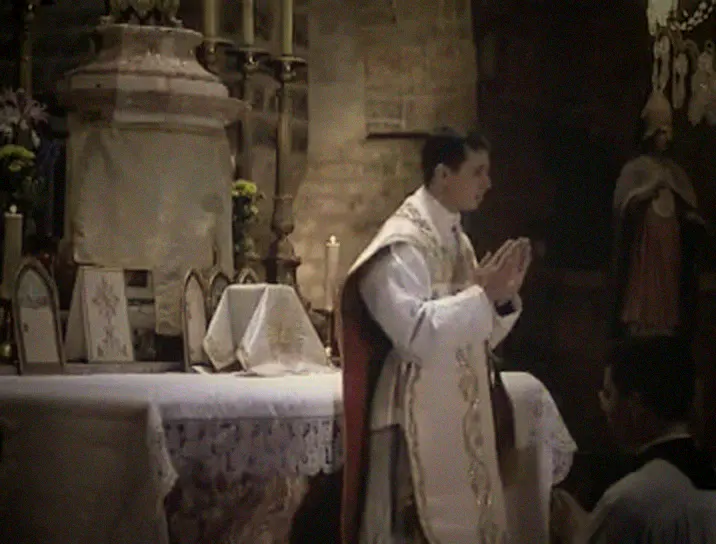
  2. The priest at the centre of the altar, hands joined.
    3 Aloud

    Kyrie

    Back at the centre, nine petitions in Greek, alternating priest and server.

    Kýrie, eléison.

    Lord, have mercy.

    Priest

    Kýrie, eléison.

    Lord, have mercy.

    Server

    Kýrie, eléison.

    Lord, have mercy.

    Priest

    Kýrie, eléison.

    Lord, have mercy.

    Server

    Christe, eléison.

    Christ, have mercy.

    Priest

    Christe, eléison.

    Christ, have mercy.

    Server

    Christe, eléison.

    Christ, have mercy.

    Priest

    Kýrie, eléison.

    Lord, have mercy.

    Server

    Kýrie, eléison.

    Lord, have mercy.

    Priest

    Kýrie, eléison.

    Lord, have mercy.

    History & meaning 4
    1. The remnant of a litany

      The Roman Mass seems once to have opened with a litany of petitions, as Eastern liturgies still do. The people's Greek reply, Kyrie eleison, pushed out the older Latin responses and in the end was the only part of that litany left.

      Catholic Encyclopedia, “Kyrie Eleison” (1910) ↗
    2. Greek, but borrowed

      The Mass at Rome was once said in Greek, but the Kyrie is not a leftover from that period. It was borrowed from the East later; the first Western evidence is a council at Vaison in 529, which calls it a custom newly brought into Rome and Italy.

      Catholic Encyclopedia, “Kyrie Eleison” (1910) ↗
    3. Christe eleison is Roman

      The middle invocation, Christe eleison, is found only in the Roman Rite. St. Gregory the Great pointed to it when he denied that Rome was copying Constantinople.

      Catholic Encyclopedia, “Kyrie Eleison” (1910) ↗
    4. Why nine

      In the 7th-century papal Mass, the choir kept repeating the Kyrie until the pope signalled them to stop. By the 8th century the number was fixed at three Kyries, three Christes and three Kyries. Durandus linked the nine calls to the nine choirs of angels.

      Catholic Encyclopedia, “Kyrie Eleison” (1910) ↗
  3. The priest extends his hands as he begins the Gloria.
    4 Aloud

    Gloria

    On Sundays and feasts outside the penitential seasons: the hymn of the angels at Bethlehem.

    Glória in excélsis Deo. Et in terra pax homínibus bonæ voluntátis.

    Glory be to God on high, and on earth peace to men of good will.

    When it is said. He bows his head at the name of Jesus.

    Priest

    Glória in excélsis Deo. Et in terra pax homínibus bonæ voluntátis. Laudámus te. Benedícimus te. Adorámus te. Glorificámus te. Grátias ágimus tibi propter magnam glóriam tuam. Dómine Deus, Rex cæléstis, Deus Pater omnípotens. Dómine Fili unigénite, Jesu Christe. Dómine Deus, Agnus Dei, Fílius Patris. Qui tollis peccáta mundi, miserére nobis. Qui tollis peccáta mundi, súscipe deprecatiónem nostram. Qui sedes ad déxteram Patris, miserére nobis. Quóniam tu solus Sanctus. Tu solus Dóminus. Tu solus Altíssimus, Jesu Christe. Cum Sancto Spíritu ✠ in glória Dei Patris. Amen.

    Glory be to God on high, and on earth peace to men of good will. We praise Thee. We bless Thee. We adore Thee. We glorify Thee. We give Thee thanks for Thy great glory. O Lord God, heavenly King, God the Father almighty. O Lord Jesus Christ, the only begotten Son. O Lord God, Lamb of God, Son of the Father. Who takest away the sins of the world, have mercy on us. Who takest away the sins of the world, receive our prayer. Who sittest at the right hand of the Father, have mercy on us. For Thou only art holy. Thou only art the Lord. Thou only art most high, O Jesus Christ. Together with the Holy Ghost ✠ in the glory of God the Father. Amen.

    History & meaning 4
    1. The angels' song, expanded

      The hymn starts with the angels' words at Bethlehem (Luke 2:14) and continues as an ancient Greek morning hymn. Tradition says St. Hilary of Poitiers brought it into Latin, possibly after his exile in the East.

      Catholic Encyclopedia, “Gloria in Excelsis Deo” (1909) ↗
    2. Once for bishops only

      The Liber Pontificalis says the Gloria was first sung at Christmas and later on Sundays and martyrs' feasts, but only by bishops. Early Roman sources let priests sing it only at Easter, and priests did not generally say it until the late 11th century.

      Catholic Encyclopedia, “Gloria in Excelsis Deo” (1909) ↗
    3. When Advent had a Gloria

      Until the end of the 12th century, Rome sang the Gloria in Advent and wore white vestments for it. Advent only later came to be treated as a penitential season like Lent, which brought violet vestments and dropped the Gloria.

      Catholic Encyclopedia, “Gloria in Excelsis Deo” (1909) ↗
    4. Tied to the Te Deum

      Under the 1962 rubrics, the Mass of the day has a Gloria whenever the Te Deum was said at Matins in the Divine Office. It is left out at Masses in violet vestments and at Requiems.

      Rubricae generales Missalis (1960 rubrics of the 1962 Missal), English translation, Divinum Officium ↗
  4. The priest at the altar with the server kneeling below.
    5 Aloud

    Collect Oratio

    The priest turns, greets the people, and returns to the book for the day's prayer.

    Dóminus vobíscum.

    The Lord be with you.

    He kisses the altar and turns to the people.

    Priest

    Dóminus vobíscum.

    The Lord be with you.

    Server

    Et cum spíritu tuo.

    And with thy spirit.

    Priest

    Orémus.

    Let us pray.

    Oratio · The Collect

    The prayer of the day, ending “…per ómnia sǽcula sæculórum”.

    Server

    Amen.

    Amen.

    History & meaning 4
    1. Why it is called a collect

      On station days, the people of Rome gathered at one church and then walked in procession to the church where Mass would be said. The prayer said over that gathering (collecta) gave the collect its name. Innocent III later read the name as the priest “collecting” everyone's prayers into one.

      Catholic Encyclopedia, “Collect” (1908) ↗
    2. Oremus, then silence

      “Let us pray” once introduced a period of silent prayer, often made kneeling, which the collect then summed up. That is why the old collects are so short. The full form survives on days when the Missal has Flectamus genua and Levate.

      Catholic Encyclopedia, “Collect” (1908) ↗
    3. “And with thy spirit”

      The greeting Dominus vobiscum comes from Scripture: Boaz uses it to greet his reapers in Ruth 2:4. The reply Et cum spiritu tuo is a Hebrew idiom in which “your spirit” simply means “you.”

      Catholic Encyclopedia, “Collect” (1908) ↗
    4. Originally only one

      The early sacramentaries give each Mass only one collect. In the 9th century Amalarius noticed some priests adding more, though Rome still used one, and in time more and more were added.

      Catholic Encyclopedia, “Collect” (1908) ↗
  5. The priest reads at the missal on the Epistle side.
    6 Aloud

    Epistle Epistola

    A reading, usually from the letters of the Apostles, then the chants between the readings.

    Deo grátias.

    Thanks be to God.

    Epistola · The Epistle

    Proper to the day, read at the Epistle side of the altar.

    Server

    Deo grátias.

    Thanks be to God.

    Graduale · Gradual, Alleluia or Tract

    Chants from the psalms, proper to the day.

    History & meaning 4
    1. Two psalms, squeezed together

      There was once a psalm after each reading. When Rome dropped the Old Testament lesson in the 5th century, the two psalms stayed but ended up side by side. The first shrank into the Gradual and the second into the Alleluia or Tract.

      Catholic Encyclopedia, “Gradual” (1909) ↗
    2. The Tract is not “drawn out”

      The Tract got its name because it was sung straight through, with no response from the choir (in uno tractu). Later writers, Durandus among them, read the name as “drawn out” and mournful. On the First Sunday of Lent it is still almost the whole of Psalm 90.

      Catholic Encyclopedia, “Gradual” (1909) ↗
    3. Alleluia, once only at Easter

      Before St. Gregory the Great, Rome seems to have sung the Alleluia only in Eastertide. That link with Easter is why it gives way to the Tract in penitential seasons. In the East it is sung even at funerals.

      Catholic Encyclopedia, “Gradual” (1909) ↗
    4. Why the Epistle side

      Large old churches often had two ambos, or pulpits: the north one for the Gospel and the other for the remaining readings. Fortescue explains that reading the Epistle on the south side preserves the tradition of that south ambo.

      Adrian Fortescue, The Mass: A Study of the Roman Liturgy (1912), p. 264 ↗
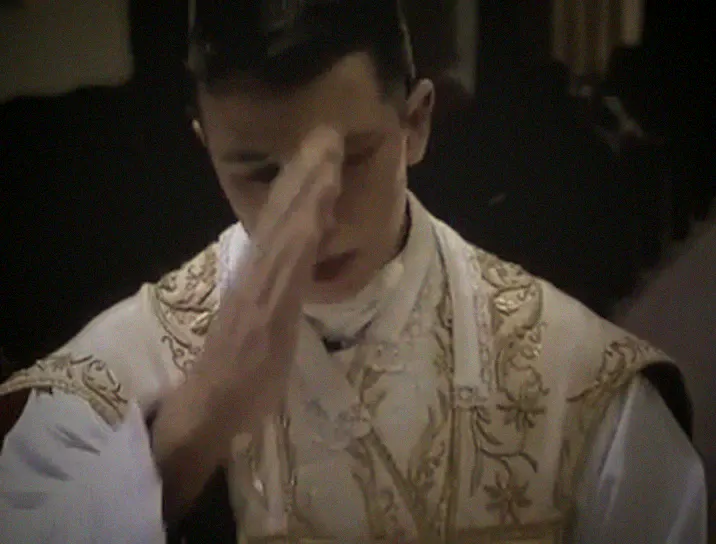
  6. The priest signs his forehead with the cross at the Gospel.
    7 Partly silent

    Gospel Evangelium

    The missal is carried to the left-hand (Gospel) side. Everyone stands for the Gospel.

    Glória tibi, Dómine.

    Glory be to Thee, O Lord.

    Bowing at the centre of the altar, he asks God to cleanse his lips.

    Priest Silently

    Munda cor meum ac lábia mea, omnípotens Deus, qui lábia Isaíæ Prophétæ cálculo mundásti igníto: ita me tua grata miseratióne dignáre mundáre, ut sanctum Evangélium tuum digne váleam nuntiáre. Per Christum, Dóminum nostrum. Amen.

    Cleanse my heart and my lips, O almighty God, who didst cleanse the lips of the prophet Isaias with a burning coal, and vouchsafe, through Thy gracious mercy, so to purify me, that I may worthily announce Thy holy Gospel. Through Christ our Lord. Amen.

    Jube, Dómine, benedícere. Dóminus sit in corde meo et in lábiis meis: ut digne et competénter annúntiem Evangélium suum. Amen.

    Give me Thy blessing, O Lord. The Lord be in my heart and on my lips, that I may worthily and in a becoming manner, proclaim His holy Gospel. Amen.

    Priest

    Dóminus vobíscum.

    The Lord be with you.

    Server

    Et cum spíritu tuo.

    And with thy spirit.

    He signs the book, then his forehead, lips and breast.

    Priest

    Sequéntia ✠ sancti Evangélii secúndum N.

    The continuation ✠ of the holy Gospel according to N.

    Server

    Glória tibi, Dómine.

    Glory be to Thee, O Lord.

    Evangelium · The Gospel

    Proper to the day.

    Server

    Laus tibi, Christe.

    Praise be to Thee, O Christ.

    He kisses the book.

    Priest Silently

    Per Evangélica dicta, deleántur nostra delícta.

    By the words of the Gospel may our sins be blotted out.

    History & meaning 4
    1. Why the north side

      At High Mass the deacon goes in procession to the north side of the sanctuary to sing the Gospel. At Low Mass the priest takes the deacon's part, so the book moves to that side. Fortescue notes that the influence also ran the other way: the deacon came to face north in imitation of Low Mass.

      Catholic Encyclopedia, “Liturgy of the Mass” (1910) ↗
    2. A late prayer

      The Munda cor meum asks God to cleanse the reader's lips as he cleansed Isaiah's with a burning coal. Fortescue dates its first appearance to a 14th-century Roman Ordo and notes that many missals still lacked it in the 1500s.

      Adrian Fortescue, The Mass: A Study of the Roman Liturgy (1912), p. 281 ↗
    3. Before Laus tibi, Christe

      Older answers to the Gospel included “Amen,” “Deo gratias” and “Blessed is he who comes in the name of the Lord.” The answer now used, “Praise to thee, O Christ,” appears to be a later one.

      Catholic Encyclopedia, “Gospel in the Liturgy” (1909) ↗
    4. Everyone once kissed the book

      The priest kisses the Gospel as he says Per evangelica dicta. In the early Roman rite, everyone present kissed the Gospel book until Pope Honorius III (1216–27) forbade it.

      Catholic Encyclopedia, “Gospel in the Liturgy” (1909) ↗
  7. 8 Aloud

    Creed Credo

    On Sundays and greater feasts, the Nicene Creed. A sermon, if there is one, usually comes before it.

    Credo in unum Deum, Patrem omnipoténtem, factórem cæli et terræ,

    I believe in one God, the Father almighty, Maker of heaven and earth,

    When it is said. He genuflects at “Et incarnátus est”.

    Priest

    Credo in unum Deum, Patrem omnipoténtem, factórem cæli et terræ, visibílium ómnium et invisibílium. Et in unum Dóminum Jesum Christum, Fílium Dei unigénitum. Et ex Patre natum ante ómnia sǽcula. Deum de Deo, Lumen de Lúmine, Deum verum de Deo vero. Génitum, non factum, consubstantiálem Patri: per quem ómnia facta sunt. Qui propter nos hómines et propter nostram salútem descéndit de cælis. Et incarnátus est de Spíritu Sancto ex María Vírgine: Et homo factus est. Crucifíxus étiam pro nobis: sub Póntio Piláto passus, et sepúltus est. Et resurréxit tértia die, secúndum Scriptúras. Et ascéndit in cælum: sedet ad déxteram Patris. Et íterum ventúrus est cum glória judicáre vivos et mórtuos: cujus regni non erit finis. Et in Spíritum Sanctum, Dóminum et vivificántem: qui ex Patre Filióque procédit. Qui cum Patre et Fílio simul adorátur et conglorificátur: qui locútus est per Prophétas. Et unam sanctam cathólicam et apostólicam Ecclésiam. Confíteor unum baptísma in remissiónem peccatórum. Et exspécto resurrectiónem mortuórum. Et vitam ventúri sæculi. Amen.

    I believe in one God, the Father almighty, Maker of heaven and earth, and of all things, visible and invisible. And in one Lord Jesus Christ, the only begotten Son of God. And born of the Father, before all ages. God of God: Light of Light: true God of true God. Begotten, not made, consubstantial with the Father, by whom all things were made. Who, for us men, and for our salvation, came down from heaven. Here kneel down. And became incarnate by the Holy Ghost of the Virgin Mary: and was made man. He was crucified also for us, suffered under Pontius Pilate, and was buried. And the third day He rose again according to the Scriptures. And ascended into heaven, and sitteth at the right hand of the Father. And He shall come again with glory to judge both the living and the dead, of whose kingdom there shall be no end. And in the Holy Ghost, the Lord and Giver of Life, proceeding from the Father and the Son. Who together, with the Father and the Son, is adored and glorified: Who spoke by the prophets. And in one, holy, Catholic and Apostolic Church. I confess one baptism for the remission of sins. And I look for the resurrection of the dead. And the life of the world to come. Amen.

    History & meaning 4
    1. Rome held out until 1014

      Rome added the Creed to Mass late. When Emperor Henry II was crowned there in 1014, he asked why it was missing and was told that Rome had never been stained by heresy, so it did not need one. Pope Benedict VIII still gave in and had it sung after the Gospel.

      Adrian Fortescue, The Mass: A Study of the Roman Liturgy (1912), p. 288 ↗
    2. Born as a protest

      Creeds began as professions of faith at baptism, not at Mass. The Nicene Creed was first put into the Eucharist at Antioch (471) and Constantinople (511), by Monophysite bishops protesting against the Council of Chalcedon.

      Catholic Encyclopedia, “Liturgical Use of Creeds” (1908) ↗
    3. Not at every Mass

      The Creed is said only on Sundays and certain feasts. Fortescue took this as a sign that it is a later addition rather than an essential part of the rite.

      Adrian Fortescue, The Mass: A Study of the Roman Liturgy (1912), p. 288 ↗
    4. Kneeling at Et incarnatus est

      The priest genuflects as he says “Et incarnatus est.” At a sung Mass the seated clergy only bow while the choir sings these words, except at the three Christmas Masses and on the Annunciation, when all kneel.

      Rubricae generales Missalis (1960 rubrics of the 1962 Missal), English translation, Divinum Officium ↗

Part III

Offertory Offertorium

The bread and wine are offered, the priest washes his fingers, and he asks the people to pray that the sacrifice be acceptable. Almost all of it is said in silence.

Watch for The priest turns to the people, says “Orate, fratres” a little aloud, and turns back to finish the sentence in silence.

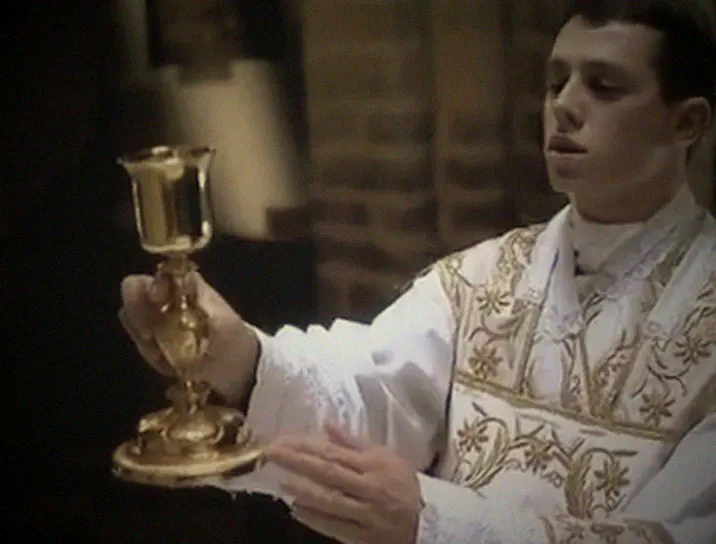
  1. The priest raises the chalice at the Offertory.
    9 Silent

    Offertory Offertorium

    The Mass of the Faithful begins. The priest offers the bread and the wine, almost entirely in silence.

    Súscipe, sancte Pater, omnípotens ætérne Deus, hanc immaculátam hóstiam,

    Accept, O holy Father, almighty and eternal God, this unspotted host,

    He kisses the altar and turns to the people.

    Priest

    Dóminus vobíscum.

    The Lord be with you.

    Server

    Et cum spíritu tuo.

    And with thy spirit.

    Priest

    Orémus.

    Let us pray.

    Offertorium · The Offertory verse

    Proper to the day.

    He holds up the paten with the Host.

    Priest Silently

    Súscipe, sancte Pater, omnípotens ætérne Deus, hanc immaculátam hóstiam, quam ego indígnus fámulus tuus óffero tibi Deo meo vivo et vero, pro innumerabílibus peccátis, et offensiónibus, et neglegéntiis meis, et pro ómnibus circumstántibus, sed et pro ómnibus fidélibus christiánis vivis atque defúnctis: ut mihi, et illis profíciat ad salútem in vitam ætérnam. Amen.

    Accept, O holy Father, almighty and eternal God, this unspotted host, which I, Thy unworthy servant, offer unto Thee, my living and true God, for my innumerable sins, offenses, and negligences, and for all here present: as also for all faithful Christians, both living and dead, that it may avail both me and them for salvation unto life everlasting. Amen.

    He pours wine and a little water into the chalice, blessing the water.

    Deus, ✠ qui humánæ substántiæ dignitátem mirabíliter condidísti, et mirabílius reformásti: da nobis per hujus aquæ et vini mystérium, ejus divinitátis esse consórtes, qui humanitátis nostræ fíeri dignátus est párticeps, Jesus Christus, Fílius tuus, Dóminus noster: Qui tecum vivit et regnat in unitáte Spíritus Sancti Deus: per ómnia sǽcula sæculórum. Amen.

    O God, who, in creating human nature, didst wonderfully dignify it, and still more wonderfully restore it, grant that, by the Mystery of this water and wine, we may be made partakers of His divine nature, who vouchsafed to be made partaker of our human nature, even Jesus Christ our Lord, Thy Son, who with Thee, liveth and reigneth in the unity of the Holy Ghost, God: world without end. Amen.

    He holds up the chalice.

    Offérimus tibi, Dómine, cálicem salutáris, tuam deprecántes cleméntiam: ut in conspéctu divínæ majestátis tuæ, pro nostra et totíus mundi salúte, cum odóre suavitátis ascéndat. Amen.

    We offer unto Thee, O Lord, the chalice of salvation, beseeching Thy clemency, that it may ascend before Thy divine Majesty, as a sweet savor, for our salvation, and for that of the whole world. Amen.

    Bowing, hands joined on the altar.

    In spíritu humilitátis et in ánimo contríto suscipiámur a te, Dómine: et sic fiat sacrifícium nostrum in conspéctu tuo hódie, ut pláceat tibi, Dómine Deus.

    Accept us, O Lord, in the spirit of humility and contrition of heart, and grant that the sacrifice which we offer this day in Thy sight may be pleasing to Thee, O Lord God.

    He blesses the offerings.

    Veni, sanctificátor omnípotens ætérne Deus: et béne ✠ dic hoc sacrifícium, tuo sancto nómini præparátum.

    Come, O almighty and eternal God, the Sanctifier, and bless ✠ this Sacrifice, prepared for the glory of Thy holy Name.

    History & meaning 4
    1. The verse is a shrunken psalm

      The short Offertory verse is all that is left of a whole psalm sung with an antiphon while the gifts were brought up. By the time of the Gregorian Antiphonary it had already been cut to a few verses, and later to the antiphon alone.

      Catholic Encyclopedia, “Offertory” (1911) ↗
    2. Medieval prayers, made official in 1570

      The old Roman rite had no spoken prayers here before the Secret. The prayers the priest now says over the bread and wine came from northern Europe in the Middle Ages, began as his private devotions, and were only printed in the Ordinary in Pius V’s Missal of 1570.

      Catholic Encyclopedia, “Offertory” (1911) ↗
    3. Borrowed from far and wide

      The prayers were gathered from several sources. The Suscipe sancte Pater first appears in the prayer book of Charles the Bald (875–877), the water blessing adapts an old Christmas collect, and the Offerimus and Veni sanctificator come from the Mozarabic rite of Spain.

      Catholic Encyclopedia, “Offertory” (1911) ↗
    4. Why water goes in the wine

      Fortescue gives a plain historical reason: people in the ancient world, Jews included, drank their wine mixed with water, so Christ almost certainly used a mixed cup at the Last Supper. Only later was the mixture read as a symbol, of Christ’s two natures or of our union with him.

      Adrian Fortescue, The Mass: A Study of the Roman Liturgy (1912), pp. 305–306 ↗
  2. Water is poured over the priest's fingers at the Lavabo.
    10 Silent

    Washing of the Hands Lavabo

    At the Epistle side the server pours water over the priest's fingers.

    Lavábo inter innocéntes manus meas: et circúmdabo altáre tuum, Dómine:

    I will wash my hands among the innocent: and I will compass Thine altar, O Lord,

    Priest Silently

    Lavábo inter innocéntes manus meas: et circúmdabo altáre tuum, Dómine: Ut áudiam vocem laudis, et enárrem univérsa mirabília tua. Dómine, diléxi decórem domus tuæ et locum habitatiónis glóriæ tuæ. Ne perdas cum ímpiis, Deus, ánimam meam, et cum viris sánguinum vitam meam: In quorum mánibus iniquitátes sunt: déxtera eórum repléta est munéribus. Ego autem in innocéntia mea ingréssus sum: rédime me et miserére mei. Pes meus stetit in dirécto: in ecclésiis benedícam te, Dómine.

    I will wash my hands among the innocent: and I will compass Thine altar, O Lord, That I may hear the voice of praise: and tell of all Thy wonderous works. I have loved, O Lord, the beauty of Thy house and the place where Thy glory dwelleth. Take not away my soul, O God, with the wicked: nor my life with blood-thirsty men. In whose hands are iniquities, their right hand is filled with gifts. But I have walked in my innocence: redeem me, and have mercy on me. My foot hath stood in the direct way, in the churches I will bless Thee, O Lord.

    History & meaning 4
    1. Practical before symbolic

      At Rome the washing during Mass had a plain cause. After receiving loaves and flasks of wine from the people at the Offertory, the celebrant needed to clean his hands.

      Catholic Encyclopedia, “Lavabo” (1910) ↗
    2. The psalm came later

      The earliest Roman ceremonial books describe the washing but give no prayer for it. Verses from Psalm 25 first appear in medieval commentators such as Durandus. They were probably a fitting private devotion long before they were written down.

      Catholic Encyclopedia, “Lavabo” (1910) ↗
    3. A symbol of a clean soul

      The symbolic reading is very old. St Cyril of Jerusalem already explained the washing as a sign of purity of soul, and medieval writers including St Thomas Aquinas kept to that idea.

      Catholic Encyclopedia, “Lavabo” (1910) ↗
    4. No Gloria in Passiontide or at Requiems

      The psalm normally ends with the Gloria Patri. It is left out in Masses for the dead and in the seasonal Masses of Passiontide.

      Catholic Encyclopedia, “Lavabo” (1910) ↗
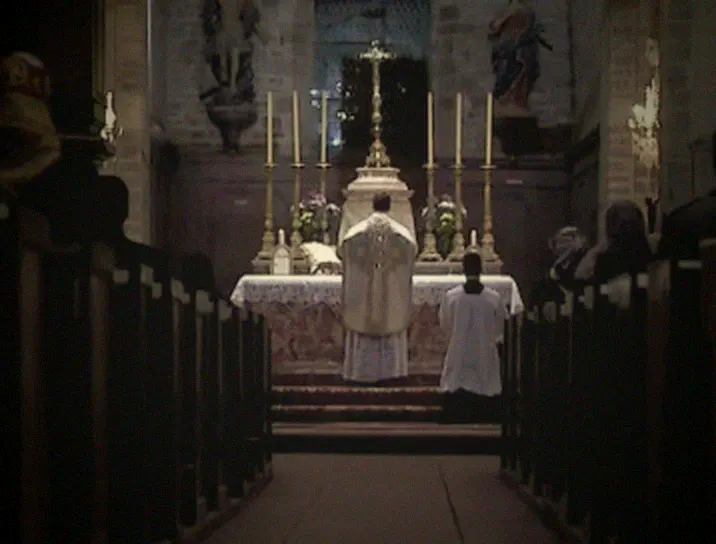
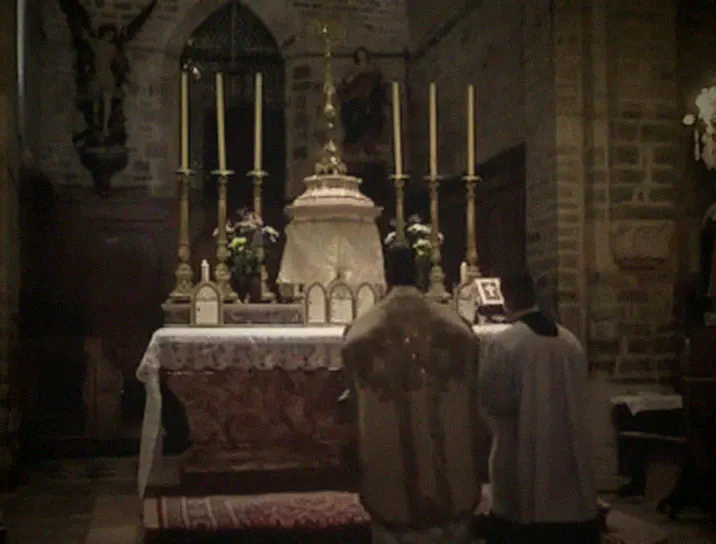
  3. The altar seen from the nave, between the pews.
    11 Partly silent

    Pray, Brethren Orate, fratres

    Oráte, fratres: ut meum ac vestrum sacrifícium acceptábile fiat apud Deum Patrem omnipoténtem.

    Brethren, pray that my Sacrifice and yours may be acceptable to God the Father almighty.

    Bowing at the centre of the altar.

    Priest Silently

    Súscipe, sancta Trínitas, hanc oblatiónem, quam tibi offérimus ob memóriam passiónis, resurrectiónis, et ascensiónis Jesu Christi, Dómini nostri: et in honórem beátæ Maríæ semper Vírginis, et beáti Joannis Baptistæ, et sanctórum Apostolórum Petri et Pauli, et istórum et ómnium Sanctórum: ut illis profíciat ad honórem, nobis autem ad salútem: et illi pro nobis intercédere dignéntur in cælis, quorum memóriam ágimus in terris. Per eúndem Christum, Dóminum nostrum. Amen.

    Receive, O holy Trinity, this oblation which we make to Thee, in memory of the Passion, Resurrection and Ascension of our Lord Jesus Christ, and in honor of Blessed Mary, ever Virgin, blessed John the Baptist, the holy Apostles Peter and Paul, and of all the Saints, that it may avail unto their honor and our salvation, and may they vouchsafe to intercede for us in heaven, whose memory we celebrate on earth. Through the same Christ our Lord. Amen.

    He kisses the altar, turns, and raises his voice a little for the first words only.

    Priest Half aloud

    Oráte, fratres: ut meum ac vestrum sacrifícium acceptábile fiat apud Deum Patrem omnipoténtem.

    Brethren, pray that my Sacrifice and yours may be acceptable to God the Father almighty.

    Server

    Suscípiat Dóminus sacrifícium de mánibus tuis ad laudem et glóriam nominis sui, ad utilitátem quoque nostram, totiúsque Ecclésiæ suæ sanctæ.

    May the Lord receive the Sacrifice from thy hands, to the praise and glory of His Name, to our benefit and that of all His holy Church.

    Priest Silently

    Amen.

    Amen.

    Secreta · The Secret

    The prayer over the offerings, said silently. Only its last words are heard.

    Priest

    Per ómnia sǽcula sæculórum.

    World without end.

    Server

    Amen.

    Amen.

    History & meaning 4
    1. Another medieval latecomer

      The Suscipe sancta Trinitas, which sums up the Offertory, is also a medieval addition from outside Rome. Some medieval rites left it out entirely, and it became universal only with the Missal of 1570.

      Adrian Fortescue, The Mass: A Study of the Roman Liturgy (1912), p. 311 ↗
    2. Why only two words are heard

      Orate fratres is a medieval expansion of the simple Oremus. The priest turns and says the first two words aloud, then finishes quietly. Fortescue argued it was never part of the old Roman Mass, which is why it is said and never sung.

      Catholic Encyclopedia, “Orate Fratres” (1911) ↗
    3. Why it is called the Secret

      The Secret got its name because it was said quietly while the choir sang the Offertory chant, at first the only prayer said that way. For the same reason it has no Oremus before it. Its closing words, Per omnia saecula saeculorum, are said aloud and lead into the Preface.

      Catholic Encyclopedia, “Secret” (1912) ↗
    4. The original Offertory prayer

      Before the medieval prayers were added, the Secret was the Roman rite’s only Offertory prayer, said after the gifts were offered in silence. The oldest Secrets, in the Leonine Sacramentary, already ask God to accept and sanctify these gifts.

      Catholic Encyclopedia, “Secret” (1912) ↗

Part IV

Canon Canon Missæ

The Preface and Sanctus, then the Canon: the unchanging prayer at the heart of the Mass, including the words of Consecration. All of it is said silently.

Watch for The bells. They ring at the Sanctus and at each elevation, when the Host and then the chalice are raised for all to see.

  1. The priest prays the Preface with his hands extended.
    12 Aloud Bells

    Preface Præfatio

    The great prayer of thanksgiving opens with a dialogue that is among the oldest words of the liturgy.

    Sursum corda.

    Lift up your hearts.

    Priest

    Dóminus vobíscum.

    The Lord be with you.

    Server

    Et cum spíritu tuo.

    And with thy spirit.

    Priest

    Sursum corda.

    Lift up your hearts.

    Server

    Habémus ad Dóminum.

    We have lifted them up to the Lord.

    Priest

    Grátias agámus Dómino, Deo nostro.

    Let us give thanks to the Lord our God.

    Server

    Dignum et justum est.

    It is meet and just.

    Præfatio · The Preface

    Changes with the season and feast.

    The server rings the bell.

    Priest Half aloud

    Sanctus, Sanctus, Sanctus Dóminus, Deus Sábaoth. Pleni sunt cæli et terra glória tua. Hosánna in excélsis. Benedíctus, qui venit in nómine Dómini. Hosánna in excélsis.

    Holy, Holy, Holy, Lord God of Sabaoth! Heaven and earth are full of Thy glory! Hosanna in the highest! Blessed is He that cometh in the Name of the Lord! Hosanna in the highest!

    History & meaning 4
    1. One of the oldest formulas

      Sursum corda (“Lift up your hearts”) is among the oldest liturgical words known. St Cyprian quoted it and its reply in the third century, and some form of the dialogue stands at this point in every rite.

      Catholic Encyclopedia, “Preface” (1911) ↗
    2. An echo of Jewish grace

      The invitation Gratias agamus Domino Deo nostro (“Let us give thanks to the Lord our God”) closely matches the Jewish blessing said before meals, as recorded in the Mishnah.

      Catholic Encyclopedia, “Preface” (1911) ↗
    3. The Preface was once the Canon

      The Preface is historically the opening of the Eucharistic prayer itself, the part that kept the theme of thanksgiving. The Sanctus split it off, and from about the seventh century Rome treated it as a separate prayer.

      Catholic Encyclopedia, “Preface” (1911) ↗
    4. Where the Sanctus bell came from

      The Sanctus bell grew out of the medieval Elevation bell, which called people to come and see the Host. Ringing at the Sanctus was an earlier warning that the Canon was about to begin. In 1912 the Missal’s rubrics did not mention it, though it was the general custom.

      Catholic Encyclopedia, “Sanctus” (1912) ↗
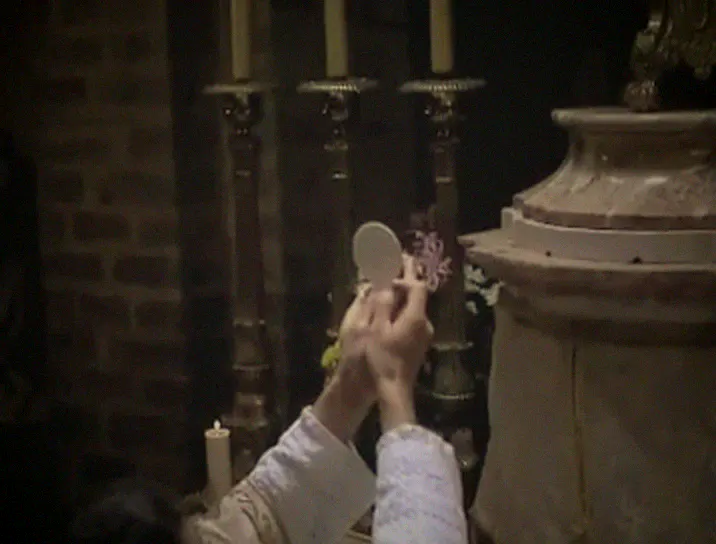
  2. The priest elevates the consecrated Host.
    13 Silent Bells

    Canon of the Mass Canon

    The heart of the Mass, said silently from beginning to end. Watch the priest's hands: the rubrics prescribe every sign of the cross and every genuflection.

    HOC EST ENIM CORPUS MEUM.

    FOR THIS IS MY BODY.

    He raises his eyes, bows low, and kisses the altar.

    Priest Silently

    Te ígitur, clementíssime Pater, per Jesum Christum, Fílium tuum, Dóminum nostrum, súpplices rogámus, ac pétimus, uti accépta hábeas et benedícas, hæc ✠ dona, hæc ✠ múnera, hæc ✠ sancta sacrifícia illibáta, in primis, quæ tibi offérimus pro Ecclésia tua sancta cathólica: quam pacificáre, custodíre, adunáre et régere dignéris toto orbe terrárum: una cum fámulo tuo Papa nostro N. et Antístite nostro N. et ómnibus orthodóxis, atque cathólicæ et apostólicæ fídei cultóribus.

    We therefore, humbly pray and beseech Thee, most merciful Father, through Jesus Christ; Thy Son, our Lord, He kisses the altar that Thou wouldst vouchsafe to accept and bless He joins his hands and signs the oblation thrice with the Sign of the Cross. these ✠ gifts, these ✠ presents, these ✠ holy unspotted Sacrifices, Then extending his hands, he proceeds: which in the first place we offer Thee for Thy holy Catholic Church to which vouchsafe to grant peace, as also to preserve, unite, and govern it throughout the world, together with Thy servant N. our Pope, and N. our Bishop, and all orthodox believers and professors of the Catholic and Apostolic Faith.

    Meménto, Dómine, famulórum famularúmque tuarum N. et N. et ómnium circumstántium, quorum tibi fides cógnita est et nota devótio, pro quibus tibi offérimus: vel qui tibi ófferunt hoc sacrifícium laudis, pro se suísque ómnibus: pro redemptióne animárum suárum, pro spe salútis et incolumitátis suæ: tibíque reddunt vota sua ætérno Deo, vivo et vero.

    Be mindful, O Lord, of Thy servants and handmaidens, N. and N. The priest joins his hands and prays silently for those for whom he intends to pray. Then extending his hands, he proceeds: and of all here present, whose faith and devotion are known unto Thee, for whom we offer, or who offer up to Thee, this sacrifice of praise for themselves, their families and friends, for the redemption of their souls, for the health and salvation they hope for; and who now pay their vows to Thee, the everlasting, living and true God.

    et beatórum Apostolórum ac Mártyrum tuórum, Petri et Pauli, Andréæ, Jacóbi, Joánnis, Thomæ, Jacóbi, Philíppi, Bartholomǽi, Matthǽi, Simónis et Thaddǽi: Lini, Cleti, Cleméntis, Xysti, Cornélii, Cypriáni, Lauréntii, Chrysógoni, Joánnis et Pauli, Cosmæ et Damiáni: et ómnium Sanctórum tuórum; quorum méritis precibúsque concédas, ut in ómnibus protectiónis tuæ muniámur auxílio. Per eúndem Christum, Dóminum nostrum. Amen.

    and of the blessed Apostles and Martyrs Peter and Paul, Andrew, James, John, Thomas, James, Philip, Bartholomew, Matthew, Simon, and Thaddeus; Linus, Cletus, Clement, Xystus, Cornelius, Cyprian, Lawrence, Chrysogonus, John and Paul, Cosmas and Damian, and of all Thy Saints, through whose merits and prayers, grant that we may in all things be defended by the help of Thy protection. He joins his hands. Through the same Christ our Lord. Amen.

    He spreads his hands over the offerings. A bell may ring.

    Hanc ígitur oblatiónem servitútis nostræ, sed et cunctæ famíliæ tuæ,

    We therefore beseech Thee, O Lord, graciously to accept this oblation of our service, as also of Thy whole family;

    quǽsumus, Dómine, ut placátus accípias: diésque nostros in tua pace dispónas, atque ab ætérna damnatióne nos éripi, et in electórum tuórum júbeas grege numerári. Per Christum, Dóminum nostrum. Amen.

    and to dispose our days in Thy peace, preserve us from eternal damnation, and rank us in the number of Thine Elect. He joins his hands. Through the same Christ our Lord. Amen.

    Quam oblatiónem tu, Deus, in ómnibus, quǽsumus, bene ✠ díctam, adscríp ✠ tam, ra ✠ tam, rationábilem, acceptabilémque fácere dignéris: ut nobis Cor ✠ pus, et San ✠ guis fiat dilectíssimi Fílii tui, Dómini nostri Jesu Christi.

    Which oblation do Thou, O God, vouchsafe in all respects, He signs thrice the oblation with the Sign of the Cross. to bless, ✠ approve, ✠ ratify, ✠ make worthy and acceptable; He signs again the Host and chalice with the Sign of the Cross. that it may be made for us the Body ✠ and Blood ✠ of Thy most beloved Son Jesus Christ our Lord.

    Qui prídie quam paterétur, accépit panem in sanctas ac venerábiles manus suas, et elevátis óculis in cælum ad te Deum, Patrem suum omnipoténtem, tibi grátias agens, bene ✠ díxit, fregit, dedítque discípulis suis, dicens: Accípite, et manducáte ex hoc omnes.

    Who, the day before He suffered, He takes the host. took bread into His holy and venerable hands, He raises his eyes to heaven. and with His eyes lifted up towards heaven unto Thee, God, His almighty Father, giving thanks to Thee, He signs the host with the Sign of the Cross He blessed ✠ it, broke it and gave it to His disciples saying: Take and eat ye all of this,

    Bent low over the Host, he says the words of Consecration. Then he genuflects, raises the Host for all to see, and genuflects again. The bell rings at each.

    HOC EST ENIM CORPUS MEUM.

    FOR THIS IS MY BODY.

    Símili modo postquam cenátum est, accípiens et hunc præclárum Cálicem in sanctas ac venerábiles manus suas: item tibi grátias agens, bene ✠ díxit, dedítque discípulis suis, dicens: Accípite, et bíbite ex eo omnes.

    In like manner, after He had supped, He takes the chalice with both his hands. taking also this excellent chalice into His holy and venerable hands He takes the chalice in his left hand, and with his right he signs it with the Sign of the Cross. He blessed ✠ , and gave it to His disciples, saying: Take and drink ye all of this,

    The words over the chalice, then the same: genuflection, elevation, genuflection, bells.

    HIC EST ENIM CALIX SANGUINIS MEI, NOVI ET ÆTERNI TESTAMENTI: MYSTERIUM FIDEI: QUI PRO VOBIS ET PRO MULTIS EFFUNDETUR IN REMISSIONEM PECCATORUM.

    FOR THIS IS THE CHALICE OF MY BLOOD OF THE NEW AND ETERNAL TESTAMENT, THE MYSTERY OF FAITH; WHICH SHALL BE SHED FOR YOU AND FOR MANY UNTO THE REMISSION OF SINS.

    Hæc quotiescúmque fecéritis, in mei memóriam faciétis.

    As often as ye do these things, ye shall do them in remembrance of Me.

    Unde et mémores, Dómine, nos servi tui, sed et plebs tua sancta, ejúsdem Christi Fílii tui, Dómini nostri, tam beátæ passiónis, nec non et ab ínferis resurrectiónis, sed et in cælos gloriósæ ascensiónis: offérimus præcláræ majestáti tuæ de tuis donis ac datis, Hóstiam ✠ puram, Hóstiam ✠ sanctam, Hóstiam ✠ immaculátam, Panem ✠ sanctum vitæ ætérnæ, et Cálicem ✠ salútis perpétuæ.

    Wherefore, O Lord, we Thy servants, as also Thy holy people, calling to mind the blessed Passion of the same Christ, Thy Son, our Lord, and also His Resurrection from the dead and His glorious Ascension into heaven: do offer unto Thy most excellent Majesty of Thine own gifts, bestowed upon us, He joins his hands and signs thrice the Host and Chalice with the Sign of the Cross. a pure ✠ Host, a holy ✠ Host, an unspotted ✠ Host, He signs the Host and the Chalice, with the Sign of the Cross. the holy ✠ Bread of eternal life, and the Chalice ✠ of everlasting salvation.

    Supra quæ propítio ac seréno vultu respícere dignéris: et accépta habére, sicúti accépta habére dignátus es múnera púeri tui justi Abel, et sacrifícium Patriárchæ nostri Abrahæ: et quod tibi óbtulit summus sacérdos tuus Melchísedech, sanctum sacrifícium, immaculátam hóstiam.

    Upon which vouchsafe to look with a propitious and serene countenance, and to accept them, as Thou wert graciously pleased to accept the gifts of Thy just servant Abel, and the sacrifice of our patriarch Abraham, and that which Thy high priest Melchisedech offered to Thee, a holy sacrifice, an unspotted victim.

    Súpplices te rogámus, omnípotens Deus: jube hæc perférri per manus sancti Angeli tui in sublíme altáre tuum, in conspéctu divínæ majestátis tuæ: ut, quotquot ex hac altáris participatióne sacrosánctum Fílii tui Cor ✠ pus, et Sán ✠ guinem sumpsérimus, omni benedictióne cælésti et grátia repleámur. Per eúndem Christum, Dóminum nostrum. Amen.

    We most humbly beseech Thee, almighty God, command these offerings to be borne by the hands of Thy holy Angels to Thine altar on high, in the sight of Thy divine majesty, that as many He kisses the altar. as shall partake of the most holy He joins his hand, and signs the Host and the Chalice with the Sign of the Cross. Body ✠ and Blood ✠ of Thy Son He signs himself with the Sign of the Cross. at this altar, may be filled with every heavenly grace and blessing. Through the same Christ our Lord. Amen.

    Meménto étiam, Dómine, famulórum famularúmque tuárum N. et N., qui nos præcessérunt cum signo fídei, et dórmiunt in somno pacis. Ipsis, Dómine, et ómnibus in Christo quiescéntibus locum refrigérii, lucis, et pacis, ut indúlgeas, deprecámur. Per eúndem Christum, Dóminum nostrum. Amen.

    Remember also, O Lord, Thy servants and handmaids N. and N., who are gone before us with the sign of faith, and rest in the sleep of peace. He joins his hands and prays for such of the dead as he intends to pray for, then extending his hands he proceeds: To these, O Lord, and to all that rest in Christ, grant, we beseech Thee, a place of refreshment, light, and peace; He joins his hands, and bows his head: Through the same Christ our Lord. Amen.

    He strikes his breast and says the first three words a little aloud.

    Priest Half aloud

    Nobis quoque peccatóribus fámulis tuis, de multitúdine miseratiónum tuárum sperántibus, partem áliquam et societátem donáre dignéris, cum tuis sanctis Apóstolis et Martýribus: cum Joánne, Stéphano, Matthía, Bárnaba, Ignátio, Alexándro, Marcellíno, Petro, Felicitáte, Perpétua, Agatha, Lúcia, Agnéte, Cæcília, Anastásia, et ómnibus Sanctis tuis: intra quorum nos consórtium, non æstimátor mériti, sed véniæ, quǽsumus, largítor admítte. Per Christum, Dóminum nostrum.

    To us also, Thy sinful servants, confiding in the multitude of Thy mercies, vouchsafe to grant some part and fellowship with Thy holy Apostles and Martyrs, with John, Stephen, Matthias, Barnabas, Ignatius, Alexander, Marcellinus, Peter, Felicitas, Perpetua, Agatha, Lucy, Agnes, Cecilia, Anastasia, and with all Thy Saints, into whose company we beseech Thee to admit us, not weighing our merits, but pardoning our offenses. He joins his hands. Through Christ our Lord.

    Priest Silently

    Per quem hæc ómnia, Dómine, semper bona creas, sanctí ✠ ficas, viví ✠ ficas, bene ✠ dícis et præstas nobis.

    By Whom, O Lord, Thou dost ever create, He signs thrice the Host and the Chalice, saying: sanctify, ✠ quicken, ✠ bless, ✠ and give unto us all these good things.

    He makes five signs of the cross with the Host, then lifts Host and chalice together.

    Per Ip ✠ sum, et cum Ip ✠ so, et in Ip ✠ so, est tibi Deo Patri ✠ omnipoténti, in unitáte Spíritus ✠ Sancti, omnis honor, et glória.

    By Him, ✠ and with Him, ✠ and in Him ✠ He signs twice between the Chalice and his breast. is to Thee, God the Father ✠ almighty, in the unity of the Holy ✠ Ghost, He elevates a little the Chalice with the Host. all honor and glory.

    The silence breaks.

    Priest

    Per ómnia sǽcula sæculórum.

    World without end.

    Server

    Amen.

    Amen.

    History & meaning 5
    1. The silent Canon, defended at Trent

      In 1562 the Council of Trent condemned anyone who rejected the Roman custom of saying part of the Canon and the words of consecration in a low voice, and in the same canon defended mixing water with the wine.

      Council of Trent, Session XXII (1562), tr. Waterworth ↗
    2. Saints from the city of Rome

      After Our Lady, the Communicantes names twelve Apostles and twelve martyrs, arranged to balance each other. All the martyrs were local Roman saints except St Cyprian of Carthage, the only outsider in the list.

      Catholic Encyclopedia, “Canon of the Mass” (1908) ↗
    3. St Joseph joins the Canon in 1962

      On 13 November 1962 the Congregation of Rites decreed that St Joseph be named in the Communicantes, straight after Our Lady. John XXIII intended it as a keepsake and fruit of the Second Vatican Council, and it took effect on 8 December 1962.

      Sacred Congregation of Rites, Decree on inserting St Joseph’s name in the Canon (13 Nov 1962), AAS 54 (1962) 873 ↗
    4. When the elevation began

      Lifting the Host at “omnis honor et gloria”, the minor elevation, dates from the ninth century or earlier. Raising the Host right after the words of consecration began only around 1200, with Eudes de Sully, Bishop of Paris. The chalice was elevated later and less widely, and St Albans Abbey adopted it only in 1429.

      Catholic Encyclopedia, “The Elevation” (1909) ↗
    5. Three words aloud

      At Nobis quoque peccatoribus (“To us sinners also”) the priest strikes his breast and raises his voice a little. The Catholic Encyclopedia calls it the only case of part of the Canon being said aloud, the closing words apart.

      Catholic Encyclopedia, “Canon of the Mass” (1908) ↗

Part V

Communion Communio

The Our Father, the breaking of the Host, the Agnus Dei, and three silent prayers before the priest receives. Then the faithful come to the altar rail.

Watch for “Domine, non sum dignus”: three times, striking the breast, the first words just audible.

  1. The priest prays the Our Father with his hands extended.
    14 Partly silent

    The Lord's Prayer Pater noster

    The priest says the Our Father aloud. Its last petition is the server's.

    Pater noster, qui es in cælis. Sanctificétur nomen tuum.

    Our Father, who art in heaven, hallowed be Thy Name;

    Priest

    Orémus: Præcéptis salutáribus móniti, et divína institutióne formáti audémus dícere:

    Let us pray. Instructed by Thy saving precepts, and following Thy divine institution, we are bold to say:

    Pater noster, qui es in cælis. Sanctificétur nomen tuum. Advéniat regnum tuum. Fiat volúntas tua, sicut in cælo et in terra. Panem nostrum quotidiánum da nobis hódie. Et dimítte nobis débita nostra, sicut et nos dimíttimus debitóribus nostris. Et ne nos indúcas in tentatiónem:

    Our Father, who art in heaven, hallowed be Thy Name; Thy kingdom come; Thy will be done on earth as it is in heaven. Give us this day our daily bread. And forgive us our trespasses, as we forgive those who trespass against us. And lead us not into temptation.

    Server

    Sed líbera nos a malo.

    But deliver us from evil.

    Priest Silently

    Amen.

    Amen.

    Líbera nos, quǽsumus, Dómine, ab ómnibus malis, prætéritis, præséntibus et futúris: et intercedénte beáta et gloriósa semper Vírgine Dei Genetríce María, cum beátis Apóstolis tuis Petro et Paulo, atque Andréa, et ómnibus Sanctis, da propítius pacem in diébus nostris: ut, ope misericórdiæ tuæ adjúti, et a peccáto simus semper líberi et ab omni perturbatióne secúri.

    Deliver us, we beseech Thee, O Lord, from all evils, past, present, and to come; and by the intercession of the Blessed and glorious ever Virgin Mary, Mother of God, and of the holy Apostles, Peter and Paul, and of Andrew, and of all the Saints, He signs himself with the paten, and then kisses it. mercifully grant peace in our days, that through the assistance of Thy mercy we may be always free from sin, and secure from all disturbance.

    He breaks the Host over the chalice.

    Per eúndem Dóminum nostrum Jesum Christum, Fílium tuum.

    Through the same Jesus Christ, Thy Son, our Lord.

    Qui tecum vivit et regnat in unitáte Spíritus Sancti Deus.

    Who with Thee in the unity of the Holy Ghost liveth and reigneth God,

    Priest

    Per ómnia sǽcula sæculórum.

    World without end.

    Server

    Amen.

    Amen.

    He makes three crosses over the chalice with a particle of the Host.

    Priest

    Pax Dómini sit semper vobíscum.

    The peace ✠ of the Lord be ✠ always with ✠ you.

    Server

    Et cum spíritu tuo.

    And with thy spirit.

    He drops the particle into the chalice.

    Priest Silently

    Hæc commíxtio, et consecrátio Córporis et Sánguinis Dómini nostri Jesu Christi, fiat accipiéntibus nobis in vitam ætérnam. Amen.

    May this mixture and consecration of the Body and Blood of our Lord Jesus Christ be to us who receive it effectual unto eternal life. Amen.

    History & meaning 4
    1. Placed here by Gregory the Great

      Pope St Gregory the Great (590–604) gave the Our Father its present place in the Roman Mass: straight after the Canon and before the breaking of the Host.

      Catholic Encyclopedia, “Lord's Prayer” (1910) ↗
    2. Why the server answers

      In the Roman rite the priest says the Lord's Prayer alone and the people answer only its last petition, "Sed libera nos a malo." That is the server's line at a Low Mass. Eastern and Gallican rites, by contrast, had the whole congregation say it.

      Adrian Fortescue, The Mass: A Study of the Roman Liturgy (1912), p. 362 ↗
    3. The embolism and St Andrew

      The silent Libera nos picks up the last line of the Our Father and expands it into a prayer for deliverance from every evil, past, present and future. It names Our Lady, Peter, Paul and Andrew. Fortescue thought Andrew was there as the first Apostle called, the brother who brought Peter to Christ (John 1:40–42).

      Adrian Fortescue, The Mass: A Study of the Roman Liturgy (1912), p. 364 ↗
    4. Two commixtures became one

      The early papal Mass had two commixtures. At the Pax Domini, a particle consecrated at a previous Mass (the Sancta) went into the chalice as a sign that the sacrifice is one. A fragment of the newly consecrated Host followed later. Only the second survives today, with the words Haec commixtio.

      Adrian Fortescue, The Mass: A Study of the Roman Liturgy (1912), p. 367 ↗
  2. 15 Aloud

    Lamb of God Agnus Dei

    Said audibly, striking the breast at each petition.

    Agnus Dei, qui tollis peccáta mundi: miserére nobis.

    Lamb of God, who takest away the sins of the world, have mercy on us.

    Priest

    Agnus Dei, qui tollis peccáta mundi: miserére nobis.

    Lamb of God, who takest away the sins of the world, have mercy on us.

    Agnus Dei, qui tollis peccáta mundi: miserére nobis.

    Lamb of God, who takest away the sins of the world, have mercy on us.

    Agnus Dei, qui tollis peccáta mundi: dona nobis pacem.

    Lamb of God, who takest away the sins of the world, grant us peace.

    History & meaning 4
    1. Pope Sergius I, 687

      The Agnus Dei came into the Roman Mass under Pope Sergius I, who in 687 ordered clergy and people to sing it while the Host was being broken. It filled the time of the fraction.

      Catholic Encyclopedia, “Agnus Dei (in Liturgy)” (1907) ↗
    2. The Baptist's words

      The text comes most directly from the Gloria ("Qui tollis peccata mundi, miserere nobis"). Behind that lies John the Baptist pointing to Jesus: "Behold the Lamb of God, who takes away the sin of the world" (John 1:29).

      Catholic Encyclopedia, “Agnus Dei (in Liturgy)” (1907) ↗
    3. Why “dona nobis pacem”

      The Agnus Dei was at first sung once. It was being repeated three times by about the 12th century, when the third "miserere nobis" became "dona nobis pacem." The Encyclopedia suggests it prepares for the kiss of peace that follows; Innocent III linked it to troubles afflicting the Church.

      Catholic Encyclopedia, “Agnus Dei (in Liturgy)” (1907) ↗
    4. At a Requiem

      At Masses for the dead the words change: "dona eis requiem" (grant them rest) twice, then "dona eis requiem sempiternam." The priest does not strike his breast.

      Catholic Encyclopedia, “Agnus Dei (in Liturgy)” (1907) ↗
  3. The priest bows over the altar in silent prayer before his Communion.
    16 Partly silent

    The Priest's Communion Communio sacerdotis

    Three prayers of preparation, said bowing over the altar in silence.

    Dómine, non sum dignus, ut intres sub tectum meum: sed tantum dic verbo, et sanábitur ánima mea.

    Lord, I am not worthy that Thou shouldst enter under my roof; say but the word, and my soul shall be healed.

    Priest Silently

    Dómine Jesu Christe, qui dixísti Apóstolis tuis: Pacem relínquo vobis, pacem meam do vobis: ne respícias peccáta mea, sed fidem Ecclésiæ tuæ; eámque secúndum voluntátem tuam pacificáre et coadunáre dignéris: Qui vivis et regnas Deus per ómnia sǽcula sæculórum. Amen.

    O Lord Jesus Christ, who saidst to Thine Apostles: Peace I leave you, My peace I give you: regard not my sins, but the faith of Thy Church; and vouchsafe to grant her that peace and unity which is agreeable to Thy will: Who livest and reignest God, world without end. Amen.

    Dómine Jesu Christe, Fili Dei vivi, qui ex voluntáte Patris, cooperánte Spíritu Sancto, per mortem tuam mundum vivificásti: líbera me per hoc sacrosánctum Corpus et Sánguinem tuum ab ómnibus iniquitátibus meis, et univérsis malis: et fac me tuis semper inhærére mandátis, et a te numquam separári permíttas: Qui cum eódem Deo Patre et Spíritu Sancto vivis et regnas Deus in sǽcula sæculórum. Amen.

    O Lord Jesus Christ, Son of the living God, who, according to the will of Thy Father, with the cooperation of the Holy Ghost, hast by Thy death given life to the world; deliver me by this Thy most sacred Body and Blood, from all my iniquities and from all evils; and make me always cleave to Thy commandments, and suffer me never to be separated from Thee, Who livest and reignest, with the same God the Father and the Holy Ghost, God, world without end. Amen.

    Percéptio Córporis tui, Dómine Jesu Christe, quod ego indígnus súmere præsúmo, non mihi provéniat in judícium et condemnatiónem: sed pro tua pietáte prosit mihi ad tutaméntum mentis et córporis, et ad medélam percipiéndam: Qui vivis et regnas cum Deo Patre in unitáte Spíritus Sancti Deus, per ómnia sǽcula sæculórum. Amen.

    Let not the partaking of Thy Body, O Lord, Jesus Christ, which I, though unworthy, presume to receive, turn to my judgment and condemnation; but let it, through Thy mercy, become a safeguard and remedy, both for soul and body; Who with God the Father, in the unity of the Holy Ghost, livest and reignest God, world without end. Amen.

    He genuflects and takes the Host.

    Panem cæléstem accípiam, et nomen Dómini invocábo.

    I will take the Bread of heaven, and will call upon the Name of the Lord.

    Striking his breast three times, he says the first four words a little aloud.

    Priest Half aloud

    Dómine, non sum dignus, ut intres sub tectum meum: sed tantum dic verbo, et sanábitur ánima mea.

    Lord, I am not worthy that Thou shouldst enter under my roof; say but the word, and my soul shall be healed.

    Dómine, non sum dignus, ut intres sub tectum meum: sed tantum dic verbo, et sanábitur ánima mea.

    Lord, I am not worthy that Thou shouldst enter under my roof; say but the word, and my soul shall be healed.

    Dómine, non sum dignus, ut intres sub tectum meum: sed tantum dic verbo, et sanábitur ánima mea.

    Lord, I am not worthy that Thou shouldst enter under my roof; say but the word, and my soul shall be healed.

    He receives the Host.

    Priest Silently

    Corpus Dómini nostri Jesu Christi custódiat ánimam meam in vitam ætérnam. Amen.

    The Body of our Lord Jesus Christ preserve my soul unto life everlasting. Amen.

    Quid retríbuam Dómino pro ómnibus, quæ retríbuit mihi? Cálicem salutáris accípiam, et nomen Dómini invocábo. Laudans invocábo Dóminum, et ab inimícis meis salvus ero.

    What return shall I make to the Lord for all He has given to me? I will take the chalice of salvation, and call upon the Name of the Lord. Praising I will call upon the Lord, and I shall be saved from my enemies.

    He receives the Precious Blood.

    Sanguis Dómini nostri Jesu Christi custódiat ánimam meam in vitam ætérnam. Amen.

    The Blood of our Lord Jesus Christ preserve my soul unto life everlasting. Amen.

    History & meaning 4
    1. Private prayers made official

      The three silent prayers before the priest's Communion began as private devotions, and were only gradually taken into the official text of the Missal.

      Catholic Encyclopedia, “Liturgy of the Mass” (1910) ↗
    2. The peace prayer and Requiems

      The first prayer recalls Christ's words to the Apostles, "Pacem relinquo vobis" (Peace I leave you), and belongs with the kiss of peace. So at Masses for the dead, where no peace is given, the Missal leaves it out.

      Ordo Missae (Roman Missal), Divinum Officium Latin text ↗
    3. The centurion's words

      Domine, non sum dignus is the Roman centurion's answer to Jesus, who had offered to come and heal his servant (Matthew 8:8). The Mass keeps his words but changes "my servant" (puer meus) to "my soul" (anima mea).

      Matthew 8:8 (Vulgate), New Advent Bible ↗
    4. Official only since 1570

      Fathers such as Origen and St John Chrysostom recommended the centurion's words as a prayer before Communion. Even so, many medieval missals did not include them, and they were made definitively part of the rite only in 1570.

      Adrian Fortescue, The Mass: A Study of the Roman Liturgy (1912), p. 383 ↗
  4. 17 Aloud

    Communion of the Faithful Communio fidelium

    If anyone is to receive. The 1962 Missal drops the server's second Confiteor here; some places still say it.

    Ecce Agnus Dei, ecce, qui tollit peccáta mundi.

    Behold the Lamb of God, behold Him who taketh away the sins of the world.

    He turns to the people holding up a Host.

    Priest

    Ecce Agnus Dei, ecce, qui tollit peccáta mundi.

    Behold the Lamb of God, behold Him who taketh away the sins of the world.

    Dómine, non sum dignus, ut intres sub tectum meum, sed tantum dic verbo, et sanábitur ánima mea.

    Lord, I am not worthy that Thou shouldst enter under my roof; say but the word, and my soul shall be healed.

    Dómine, non sum dignus, ut intres sub tectum meum, sed tantum dic verbo, et sanábitur ánima mea.

    Lord, I am not worthy that Thou shouldst enter under my roof; say but the word, and my soul shall be healed.

    Dómine, non sum dignus, ut intres sub tectum meum, sed tantum dic verbo, et sanábitur ánima mea.

    Lord, I am not worthy that Thou shouldst enter under my roof; say but the word, and my soul shall be healed.

    To each communicant, kneeling at the rail.

    Priest Half aloud

    Corpus Dómini nostri Jesu Christi custódiat ánimam tuam in vitam ætérnam. Amen.

    The Body of our Lord Jesus Christ preserve thy soul unto life everlasting. Amen.

    History & meaning 4
    1. Borrowed from Communion outside Mass

      The prayers at the people's Communion (the Confiteor, Ecce Agnus Dei and Domine non sum dignus) were first used to give Communion outside Mass, for example to the sick. People grew used to them, and around the 13th century they began to be said within Mass too.

      Adrian Fortescue, The Mass: A Study of the Roman Liturgy (1912), p. 384 ↗
    2. No second Confiteor in 1962

      The 1960 rubrics in the 1962 Missal dropped the Confiteor and absolution that had been said before the faithful's Communion. Once the priest has received the Precious Blood, he goes straight to Ecce Agnus Dei and the threefold Domine non sum dignus.

      General Rubrics of the Roman Missal (1960), as in the 1962 Missal — Divinum Officium ↗
    3. From “Amen” to a blessing

      The ancient words of administration were simply "The body of Christ," to which the communicant answered "Amen." By Gregory the Great's time this had grown into a prayer that the Body of Christ preserve the soul, which is the root of today's Corpus Domini nostri formula.

      Adrian Fortescue, The Mass: A Study of the Roman Liturgy (1912), p. 376 ↗
    4. Kneeling at the rail

      In the early Church people received standing. The Catholic Encyclopedia dates the custom of receiving kneeling to about the 15th century and says that is how the altar rail took its modern form. Its other name, the communion rail, comes from the faithful kneeling there.

      Catholic Encyclopedia, “Communion Bench” (1908) ↗
  5. Wine and water are poured over the priest's fingers into the chalice.
    18 Partly silent

    Ablutions Ablutiones

    Wine, then wine and water, cleanse the chalice and the priest's fingers.

    Quod ore súmpsimus, Dómine, pura mente capiámus: et de múnere temporáli fiat nobis remédium sempitérnum.

    Grant, O Lord, that what we have taken with our mouth, we may receive with a pure mind; and from a temporal gift may it become to us an eternal remedy.

    Priest Silently

    Quod ore súmpsimus, Dómine, pura mente capiámus: et de múnere temporáli fiat nobis remédium sempitérnum.

    Grant, O Lord, that what we have taken with our mouth, we may receive with a pure mind; and from a temporal gift may it become to us an eternal remedy.

    Corpus tuum, Dómine, quod sumpsi, et Sanguis, quem potávi, adhǽreat viscéribus meis: et præsta; ut in me non remáneat scélerum mácula, quem pura et sancta refecérunt sacraménta: Qui vivis et regnas in sǽcula sæculórum. Amen.

    May Thy Body, O Lord, which I have received, and Thy Blood which I have drunk, cleave to my bowels; and grant that no stain of sin may remain in me, who have been fed with this pure and holy Sacrament; Who livest and reignest for ever and ever. Amen.

    Communio · The Communion verse

    Read at the Epistle side. Proper to the day.

    Priest

    Dóminus vobíscum.

    The Lord be with you.

    Server

    Et cum spíritu tuo.

    And with thy spirit.

    Postcommunio · The Postcommunion

    Proper to the day.

    Server

    Amen.

    Amen.

    History & meaning 4
    1. A practical rite

      The ablutions began as the necessary cleaning of the chalice and the priest's fingers. Over time this practical step became a ceremony. By the 14th-century Roman Ordo the arrangement was almost the one used today.

      Adrian Fortescue, The Mass: A Study of the Roman Liturgy (1912), p. 383 ↗
    2. “We” and then “I”

      Quod ore sumpsimus is an old Postcommunion found in the early sacramentaries, which is why it says "we." Corpus tuum, Domine was written as a private prayer and is in the singular.

      Adrian Fortescue, The Mass: A Study of the Roman Liturgy (1912), p. 384 ↗
    3. A chant that moved

      The Communion antiphon is what remains of a whole psalm that was sung while the people received. From the 12th century it was moved to after Communion and shortened to a single verse.

      Catholic Encyclopedia, “Communion Antiphon” (1908) ↗
    4. The Postcommunion

      The Postcommunion began as a prayer of thanksgiving and blessing. Over time it took the shape of the Collect at the start of Mass, matching it in number and form, though it usually still alludes to the Communion just received.

      Catholic Encyclopedia, “Postcommunion” (1911) ↗

Part VI

Dismissal Conclusio

“Ite, missa est”, the blessing, and the Last Gospel: the opening of St John's Gospel, read at the end of almost every Mass. At a Low Mass, prayers for the Church follow at the foot of the altar.

Watch for At “Et Verbum caro factum est”, “and the Word was made flesh”, the priest genuflects.

  1. The priest turns to the people at the end of Mass.
    19 Partly silent

    Dismissal and Blessing Conclusio

    Ite, Missa est.

    Go, the Mass is ended.

    Priest

    Dóminus vobíscum.

    The Lord be with you.

    Server

    Et cum spíritu tuo.

    And with thy spirit.

    Priest

    Ite, Missa est.

    Go, the Mass is ended.

    Server

    Deo grátias.

    Thanks be to God.

    Bowing at the centre of the altar.

    Priest Silently

    Pláceat tibi, sancta Trínitas, obséquium servitútis meæ: et præsta; ut sacrifícium, quod óculis tuæ majestátis indígnus óbtuli, tibi sit acceptábile, mihíque et ómnibus, pro quibus illud óbtuli, sit, te miseránte, propitiábile. Per Christum, Dóminum nostrum. Amen.

    May the performance of my homage be pleasing to Thee, O holy Trinity: and grant that the Sacrifice which I, though unworthy, have offered up in the sight of Thy Majesty, may be acceptable to Thee, and through Thy mercy, be a propitiation for me, and for all those for whom I have offered it. Through Christ our Lord. Amen.

    He kisses the altar, turns, and blesses the people.

    Priest

    Benedícat vos omnípotens Deus, Pater, et Fílius, ✠ et Spíritus Sanctus.

    May almighty God the Father, Son, ✠ and Holy Ghost, bless you.

    Server

    Amen.

    Amen.

    History & meaning 4
    1. “Go, it is the dismissal”

      Ite, missa est is one of the oldest Roman formulas. Missa is a late Latin word for "dismissal" (missio), not "offering." The whole service took its name, the Mass, from this sending-out of the people.

      Catholic Encyclopedia, “Liturgy of the Mass” (1910) ↗
    2. Why Benedicamus Domino

      From about the 11th century, penitential days without the Gloria ended with Benedicamus Domino instead. On those days the people were not dismissed but stayed for further prayers.

      Catholic Encyclopedia, “Ite Missa Est” (1910) ↗
    3. The 1962 rule

      The 1960 rubrics in the 1962 Missal simplified this. Ite, missa est now ends every Mass, Benedicamus Domino is kept only when a procession follows (as on Holy Thursday), and Requiems end with Requiescant in pace.

      General Rubrics of the Roman Missal (1960), as in the 1962 Missal — Divinum Officium ↗
    4. After the dismissal

      It seems odd that Mass goes on after the people are dismissed. The Placeat, the blessing and the Last Gospel were later additions, originally private devotions. The Placeat was the priest's own short prayer as he kissed the altar before turning away.

      Adrian Fortescue, The Mass: A Study of the Roman Liturgy (1912), p. 393 ↗
  2. The priest at the Gospel side for the Last Gospel.
    20 Aloud

    Last Gospel Ultimum Evangelium

    Read from the altar card at the Gospel side: the opening of St John's Gospel. The people stand.

    In princípio erat Verbum, et Verbum erat apud Deum, et Deus erat Verbum.

    In the beginning was the Word, and the Word was with God, and the Word was God.

    Priest

    Dóminus vobíscum.

    The Lord be with you.

    Server

    Et cum spíritu tuo.

    And with thy spirit.

    Priest

    Inítium ✠ sancti Evangélii secúndum Joánnem.

    The beginning ✠ of the holy Gospel according to John.

    Server

    Glória tibi, Dómine.

    Glory be to Thee, O Lord.

    He genuflects at “Et Verbum caro factum est”.

    Priest

    In princípio erat Verbum, et Verbum erat apud Deum, et Deus erat Verbum. Hoc erat in princípio apud Deum. Omnia per ipsum facta sunt: et sine ipso factum est nihil, quod factum est: in ipso vita erat, et vita erat lux hóminum: et lux in ténebris lucet, et ténebræ eam non comprehendérunt. Fuit homo missus a Deo, cui nomen erat Joánnes. Hic venit in testimónium, ut testimónium perhibéret de lúmine, ut omnes créderent per illum. Non erat ille lux, sed ut testimónium perhibéret de lúmine. Erat lux vera, quæ illúminat omnem hóminem veniéntem in hunc mundum. In mundo erat, et mundus per ipsum factus est, et mundus eum non cognóvit. In própria venit, et sui eum non recepérunt. Quotquot autem recepérunt eum, dedit eis potestátem fílios Dei fíeri, his, qui credunt in nómine ejus: qui non ex sanguínibus, neque ex voluntáte carnis, neque ex voluntáte viri, sed ex Deo nati sunt. Et Verbum caro factum est, et habitávit in nobis: et vídimus glóriam ejus, glóriam quasi Unigéniti a Patre, plenum grátiæ et veritátis.

    In the beginning was the Word, and the Word was with God, and the Word was God. The same was in the beginning with God. All things were made by Him, and without Him was made nothing that was made: in Him was life, and the life was the Light of men; and the Light shineth in darkness, and the darkness did not comprehend it. There was a man sent from God, whose name was John. This man came for a witness, to testify concerning the Light, that all might believe through Him. He was not the Light, but he was to testify concerning the Light. That was the true Light, which enlighteneth every man that cometh into this world. He was in the world, and the world was made by Him, and the world knew Him not. He came unto His own, and His own received Him not. But as many as received Him to them He gave power to become sons of God, to them that believe in His Name, who are born not of blood, nor of the will of the flesh, nor of the will of man, but of God. And the Word was made flesh, and dwelt among us: and we saw His glory, the glory as of the Only begotten of the Father, full of grace and truth.

    Server

    Deo grátias.

    Thanks be to God.

    History & meaning 4
    1. A medieval devotion

      The prologue of St John's Gospel (John 1:1–14) was a favourite devotion throughout the Middle Ages, read at baptisms and at the anointing of the sick. Priests recited it among their prayers after Mass.

      Catholic Encyclopedia, “Gospel in the Liturgy” (1909) ↗
    2. Fixed by Pius V, 1570

      Until about the 12th century, Mass ended at Ite, missa est. By the 13th century some priests said the Last Gospel at the altar, and St Pius V made this universal in his 1570 Missal. That is why it is said without the ceremony of the Mass's main Gospel.

      Catholic Encyclopedia, “Gospel in the Liturgy” (1909) ↗
    3. Kneeling at the Incarnation

      At “Et Verbum caro factum est” (“And the Word was made flesh,” John 1:14) the 1960 rubrics have all in choir genuflect, just as at the Creed’s “Et incarnatus est”: the same honour for the same mystery.

      General Rubrics of the Roman Missal (1960), as in the 1962 Missal — Divinum Officium ↗
    4. Almost always St John in 1962

      Before 1960, when a Sunday or feria was commemorated, its own Gospel often replaced St John's prologue at the end of Mass. The 1960 rubrics made John 1 the regular Last Gospel, with Palm Sunday the main exception.

      General Rubrics of the Roman Missal (1960), as in the 1962 Missal — Divinum Officium ↗
  3. Priest and server kneel at the foot of the altar for the prayers after Low Mass.
    21 Aloud

    Prayers after Low Mass Preces Leoninæ

    Kneeling at the foot of the altar, the priest leads everyone in the prayers Pope Leo XIII ordered after every Low Mass. Often said in the vernacular.

    Sancte Míchaël Archángele, defénde nos in prǽlio;

    Holy Michael Archangel, defend us in the day of battle;

    Priest

    Ave María, grátia plena, Dóminus tecum, benedícta tu in muliéribus et benedíctus fructus ventris tui, Jesus.

    Hail Mary, full of grace; The Lord is with thee; Blessed art thou amongst women, And blessed is the fruit of thy womb, Jesus.

    All

    Sancta María, Mater Dei, ora pro nobis peccatóribus, nunc et in hora mortis nostræ. Amen.

    Holy Mary, Mother of God, Pray for us sinners, now and at the hour of our death. Amen.

    Salve Regína, Mater misericórdiæ, vita, dulcédo, et spes nostra, salve. Ad te clamámus, éxsules fílii Evæ. Ad te suspirámus geméntes et flentes in hac lacrymárum valle. Eia ergo, Advocáta nostra, illos tuos misericórdes óculos ad nos convérte. Et Jesum, benedíctum fructum ventris tui, nobis, post hoc exílium, osténde. O clemens, o pia, o dulcis Virgo Mária.

    Hail, holy Queen, Mother of Mercy, our life, our sweetness, and our hope. To thee do we cry, poor banished children of Eve. To thee do we send up our sighs, mourning and weeping in this valley of tears. Turn then, most gracious Advocate, thine eyes of mercy towards us. And after this our exile, show unto us the blessed Fruit of thy womb, Jesus. O clement, O loving, O sweet Virgin Mary.

    Priest

    Ora pro nobis, sancta Dei Génitrix.

    Pray for us, O Holy Mother of God.

    All

    Ut digni efficiámur promissiónibus Christi.

    That we may be made worthy of the promises of Christ.

    Priest

    Orémus. Deus, refúgium nostrum et virtus, pópulum ad te clamántem propítius réspice; et intercedénte gloriósa, et immaculáta Vírgine Dei Genitríce María, cum beáto Joseph, ejus Sponso, ac beatis Apóstolis tuis Petro et Paulo, et ómnibus Sanctis, quas pro conversióne peccatórum, pro libertáte et exaltatióne sanctæ Matris Ecclésiæ, preces effúndimus, miséricors et benígnus exáudi. Per eúndem Christum Dóminum nostrum. Amen.

    Let us pray. O God, our refuge and our strength, look down in mercy on Thy people who cry to Thee; and by the intercession of the glorious and Immaculate Virgin Mary, Mother of God, of St. Joseph her Spouse, of Thy blessed Apostles Peter and Paul, and of all the Saints, in mercy and goodness hear our prayers for the conversion of sinners, and for the liberty and exaltation of our holy Mother the Church. Through the same Christ our Lord. Amen.

    All

    Sancte Míchaël Archángele, defénde nos in prǽlio; contra nequítiam et insídias diáboli esto præsídium. Imperet illi Deus, súpplices deprecámur: tuque, Princeps milítiæ Cæléstis, sátanam aliósque spíritus malígnos, qui ad perditiónem animárum pervagántur in mundo, divína virtúte in inférnum detrúde. Amen.

    Holy Michael Archangel, defend us in the day of battle; be our safeguard against the wickedness and snares of the devil. -- May God rebuke him, we humbly pray: and do thou, Prince of the heavenly host, by the power of God thrust down to hell Satan and all wicked spirits, who wander through the world for the ruin of souls. Amen.

    Priest

    Cor Jesu sacratíssimum.

    Most Sacred Heart of Jesus,

    All

    Miserére nobis.

    Have mercy upon us.

    Priest

    Cor Jesu sacratíssimum.

    Most Sacred Heart of Jesus,

    All

    Miserére nobis.

    Have mercy upon us.

    Priest

    Cor Jesu sacratíssimum.

    Most Sacred Heart of Jesus,

    All

    Miserére nobis.

    Have mercy upon us.

    History & meaning 3
    1. Leo XIII, 1884

      Leo XIII ordered these prayers for the whole Church after every Mass said without chant, that is, every Low Mass. In August 1884 the Congregation of Rites ruled that the priest says them alternately with the people, kneeling for the Hail Marys and Salve Regina.

      Sacred Congregation of Rites, reply of 20 August 1884, Acta Sanctae Sedis 17 (1884), p. 95 ↗
    2. Cor Jesu: encouraged, not required

      In 1904, at the faithful's request, Pius X granted an indulgence for adding "Cor Jesu sacratissimum, miserere nobis" three times after the Leonine prayers. The decree notes that the invocation is not commanded, only strongly desired by the Pope.

      S. Congregation of Indulgences, decree Urbis et Orbis of 17 June 1904, Acta Sanctae Sedis 36, p. 750 ↗
    3. For Russia, 1930

      In a consistory on 30 June 1930, Pius XI directed that the prayers Leo XIII had ordered after Mass be offered for Russia. He asked that Catholics there be given peace and the freedom to profess their faith.

      Pontifical Commission for Russia, 11 July 1930, Acta Apostolicae Sedis 22 (1930), p. 366 ↗

Text: the Ordinary of the 1962 Roman Missal, from Divinum Officium, Latin with its traditional English translation. Voice and stage directions follow the rubrics printed with it. St Thomas Aquinas explains the words and actions of the Mass of his own day in Summa Theologiae III, q. 83, which you can read in Latin and English.

Questions about the Latin Mass

What is the Traditional Latin Mass?

The Mass of the Roman Rite as it was celebrated before the reforms that followed the Second Vatican Council. It is also called the Tridentine Mass, after the Council of Trent, whose reform of the Missal Pope St Pius V promulgated in 1570. The 1962 Roman Missal is its last edition, and that is the one on this page. Since 2007 (Summorum Pontificum) it has also been called the extraordinary form; since 2021 (Traditionis custodes) its celebration needs the local bishop's permission.

Which Mass is this?

The Low Mass according to the Roman Missal of 1962, the form most often celebrated as the Traditional Latin Mass today: one priest, one server, nothing sung.

What is the difference between a Low Mass and a High Mass?

A Low Mass is said, not sung, with a single server. A High Mass (Missa cantata) sings the parts the priest says aloud, with a choir singing the Kyrie, Gloria, Sanctus and the rest, and may use incense. A Solemn High Mass adds a deacon and subdeacon. The prayers of the priest are the same in all three, so this guide works for each of them.

How long is a Latin Mass?

The Low Mass filmed for this guide runs about half an hour from the first Sign of the Cross to the last prayer, with no sermon. A sermon, the Creed, the Communion of a large congregation, or a sung Mass all add to that.

Why does the priest face the altar, with his back to the people?

Because priest and people are facing the same way, toward the altar and the Cross, praying to God together. Facing east in prayer is one of the oldest Christian customs, and for centuries churches were built with the altar at the east end. When the priest addresses the people (“Dominus vobiscum”, “Orate, fratres”, the blessing) he turns around to face them.

Why does the server answer, and not the people?

In the rubrics of the Low Mass the server answers in the name of the people. In many churches today the congregation joins him in the responses (a “dialogue Mass”); in others the people pray silently. Either way, the words are the ones on this page.

What are the Propers, and where do I find today's?

The Introit, Collect, Epistle, Gradual, Gospel, Offertory verse, Secret, Communion verse and Postcommunion change with the day. They are marked on this page as slots. Your parish may hand out a sheet, a hand missal has them all, and Divinum Officium publishes the Propers for every day of the year.

Why is so much of it said silently?

Because the rubrics prescribe it: the Offertory prayers, the whole Canon, and the priest's prayers before Communion are said “secrete”. The Council of Trent defended the practice explicitly (Session XXII, chapter 5 and canon 9). On this page, every silent line is marked.

Can I use this on my phone during Mass?

That is what it is for. Turn on “Keep screen on” so it doesn't lock between prayers, silence your phone, and lower the brightness. Many people prefer to read the page the night before and leave the phone at home. Both are good ways to use it.

Do I need a missal, or to know Latin, to attend the Latin Mass?

No to both. People have followed the Mass for centuries with a hand missal in their own language, which is what this page is; for the day's Propers, use your parish sheet, a hand missal or Divinum Officium. That said, the parts the people hear most (the Kyrie, Gloria, Sanctus, Pater Noster and Agnus Dei) become your own quickly, and knowing what the words mean changes how they sound.

Credo

Pray the Mass in its own words.

Credo teaches the Latin of the prayers you just met, the Gloria Patri, the Pater Noster, the Sanctus and the Agnus Dei among them, with short lessons and audio for every line, until the words stop being sounds and start being prayer. Try it free for a week.

Download Credo for iPhone