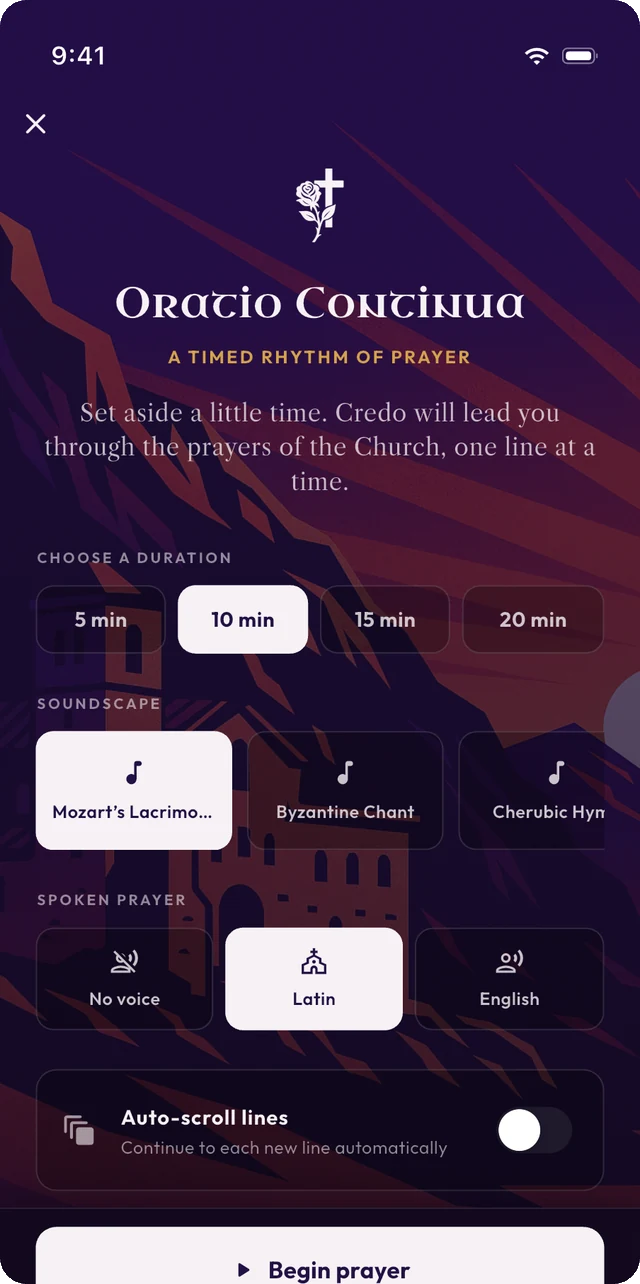
With the Credo method, you'll learn the Latin language simply by reading and praying.
No memorization, no grammar drills, just the timeless words of the faith.
Start learning for free! Looking for Android?“Simply beautiful. It’s clear that it was created with love.”
Learning Latin with Credo is easy and fun. You'll read prayers, Bible passages, and stories, during which you'll absorb an understanding of the language without even realizing it.
The Credo method is based on time-tested techniques, adapted for people learning to read Christ, not Cicero.
Learn your prayers in Latin
Learn through context and repetition
Deepen your faith while learning
Methodology
Catholics have been failing to learn Latin from grammar tables for centuries. Credo teaches it the way Latin was meant to be learned: by reading.
01
Credo's lessons follow the principle behind Lingua Latina per se illustrata: you read the language directly, no English crutch, and the meaning becomes clear through illustrations and surrounding sentences. The difference is what you're reading. Where Hans Ørberg leads you through a fictional Roman family, Credo leads you through the prayers, parables, and saints' lives at the heart of Catholic devotion.
02
Most Latin curricula begin with declensions and Caesar's Gallic Wars. Credo begins with the Sign of the Cross — and by the end of the first week, you'll be reading the Pater Noster in the same Latin the Church has prayed for sixteen centuries. Every word you learn, you will meet again at Mass.
03
Credo's lessons are illustrated in liturgical and folk traditions — woodblock, stained glass, Insular interlace, ink-and-wash. The pictures aren't decoration; they're how the natural method works. You see Maria beside an image of the Annunciation and you don't need a translation to know what the word means.
04
Credo asks why you want to learn — for prayer, for study, or both — and shapes the lesson plan around that answer. The goal is not busywork; it is enough comprehensible Latin, devotional context, and targeted review to make the language intuitive while drawing you deeper into the prayer life of the Church.
This is literally my dream app. I've wanted this for so long. I can't wait to devour this.
Simply beautiful. It's clear that it was created with love.
I really like the way it's set up.
Each word explained.
Makes it easier to learn.
And animations help me know what the words mean too.
Try a prayer
Read each prayer in Latin, line by line, with translation, vocabulary, and the Church's own devotional context. No app required.
The Lord's Prayer
The prayer Christ Himself taught — the heart of every Christian's life of prayer.
Read with translation →
Hail Mary
The greeting of the Archangel Gabriel, joined to the Church's own petition.
Read with translation →
Hail Holy Queen
The Church's evening hymn to Mary, our life, our sweetness, and our hope.
Read with translation →
Download Credo today and start learning Latin through the timeless prayers of the faith.
Common questions
Yes. The iOS app is free to download, and new subscribers can try Credo with a one-week free trial. During that week, you can begin the lesson path, pray the Sign of the Cross in Latin, and see how Credo teaches through reading, context, and Catholic prayer.
None whatsoever. Credo assumes you've never seen a Latin word in your life. By lesson six you'll be praying the Ave Maria in Latin from memory — not because you memorized it, but because you understood it as you read.
Apps like Duolingo, Pimsleur, and Babbel teach modern Latin for classical reading or general fluency. Credo teaches the Latin of the Church — the prayers, the Mass, the Vulgate, lectio divina. Every lesson is grounded in something a Catholic actually wants to pray.
The grammar is the same, but the vocabulary and aim are different. Cicero's Latin and the Church's Latin share the bones, but Catholic Latin carries fifteen hundred years of theology, liturgy, and prayer that classical Latin simply doesn't. Credo teaches the Latin you'll actually meet at Mass and in the Breviary.
Not at all. Credo is for any Catholic — Novus Ordo or Latin Mass — who wants to pray in the language of the saints. Knowing Latin transforms the experience of any Mass and unlocks two thousand years of Catholic writing, from Augustine to Aquinas to the Roman Missal.
A few weeks to read the Hail Mary fluently. A few months to read most of the common prayers. Within a year, you can be reading short Latin Bible passages, Augustine's Confessions, or the Liturgy of the Hours in Latin. The pace is yours to set; new lessons release weekly.
Instead of memorizing grammar tables, you read short illustrated Latin sentences whose meaning you can guess from the picture and the surrounding context — and over hundreds of these sentences, the language seeps in. It's the same approach behind Hans Ørberg's celebrated Lingua Latina per se illustrata, adapted for Catholic content.
Jason Victor, a Catholic engineer and entrepreneur in Miami. He started Credo because he wanted it himself: an app that taught Latin not as an academic exercise, but as a path deeper into the prayer life of the Church. Read more in the section below.
Built by
I'm Jason Victor — a Catholic entrepreneur and engineer living in Miami. I started Credo because I wanted it for myself: an app that taught Latin not as an academic exercise, but as a path deeper into the prayer life of the Church.
Before Credo, I spent more than a decade founding and building software companies, including Cloudmetrx and Routefire, both of which were acquired. At Coinbase, I later led technical work on institutional trading infrastructure used by some of the world's largest financial firms.
Credo brings that same care for serious software to something closer to home: a tool my parish would actually use, and one that treats the faith as worthy of beautiful, polished technology. The Latin of the Church belongs to every Catholic; Credo is my small contribution to giving it back.
Jason holds an A.B. in Computer Science from Dartmouth College. Credo is a product of Toggle Media, LLC.